DCA Crypto Trading Bot: A Complete Builder's Guide
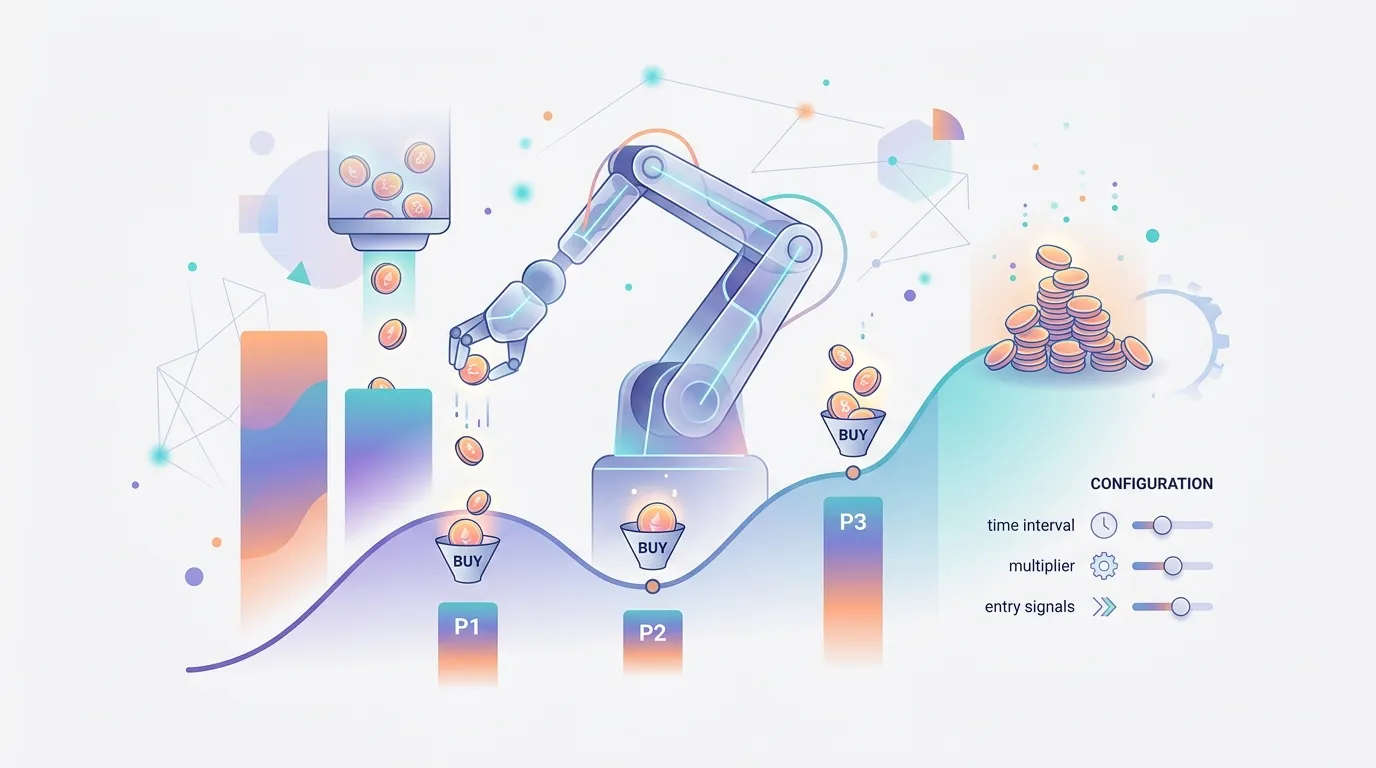
Timing the crypto market is notoriously difficult — even professional traders get it wrong. Dollar-cost averaging sidesteps the timing problem by spreading your exposure across multiple buys, and automating that process is where a DCA crypto trading bot becomes genuinely useful. This guide walks you through how the strategy works mechanically, which parameters you need to configure, how to layer in smart entry signals, and how to bring a fully functional bot to life without writing code.
What Is a DCA Crypto Trading Bot?
A DCA crypto trading bot is an automated program that executes a dollar-cost averaging strategy on your behalf. Instead of placing one large buy order at a single price, the bot splits capital into a series of smaller orders placed at predetermined intervals or after specific price drops. As the asset price falls, each subsequent buy lowers the average entry price, so the position becomes profitable sooner when price recovers.
"Dollar-cost averaging doesn't predict where the price will go — it systematically manages the price at which you're exposed."
The automation matters because manually tracking every dip across multiple assets around the clock is impractical. A bot executes the rules you set with zero emotional interference, whether markets are moving at 2 pm or 2 am.
How Does Dollar-Cost Averaging Work in Crypto Trading Bots?
DCA bots operate in a repeated cycle:
- Base order — The bot opens an initial position with a defined amount (e.g., $50 of BTC).
- Safety orders — If price drops by a set percentage threshold (e.g., 2%), the bot places an additional buy. This repeats up to a maximum number of safety orders.
- Average cost reduction — Each safety order at a lower price pulls the overall average entry price down.
- Take-profit trigger — When price rises above the average entry by a target percentage (e.g., 1.5%), the bot closes the full position and books the gain.
- Cycle reset — The bot immediately begins watching for the next entry opportunity.
This cycle means the bot profits on a relatively modest recovery rather than needing to wait for price to return to the original entry point.
Core Bot Parameters You Need to Configure
Getting a DCA bot right comes down to five parameters. Misunderstand any one of them and the strategy breaks down.
Base Order Size
This is the capital allocated to the opening trade. Keep it small relative to your total allocation for that asset — typically 10–20% of your intended maximum position — so safety orders have room to work.
Safety Order Size and Count
Safety orders are the follow-up buys. You can set them at a fixed dollar amount or as a multiplier of the base order (e.g., 1.5× each successive order). The maximum safety order count caps your total exposure. Four to six safety orders is a common starting range; more orders mean deeper drawdown coverage but higher capital commitment.
Price Deviation Step
This defines how far price must fall (as a percentage) before each safety order fires. A 2% step means safety order 1 fires at −2%, safety order 2 at −4%, and so on. Tighter steps fill up your order ladder faster during volatile moves; wider steps preserve capital but require deeper drops to average down significantly.
Take-Profit Target
Expressed as a percentage above your averaged entry price. Lower targets (0.5–1.5%) mean faster cycle turnover but smaller gains per trade. Higher targets (3–5%) capture bigger moves but tie up capital longer during sideways markets.
Cooldown Period
A mandatory wait between cycles that prevents the bot from immediately re-entering after a profitable close — useful when you want to avoid chasing a rapidly moving market.
Setting Entry Conditions with Technical Indicators
A purely mechanical DCA bot buys on every dip, including during sustained downtrends. Indicator-based entry filters help the bot pick better starting points.
RSI oversold signals are the most common filter. Configuring the bot to open a base order only when RSI(14) drops below 35 means you're starting a DCA cycle when momentum is already stretched to the downside — a statistically more favorable entry than a random time trigger.
Price deviation thresholds add a second layer: only open if price has already fallen a certain percentage from a recent high (e.g., more than 5% off the 24-hour high). This filters out entries during normal micro-fluctuations.
MACD crossovers can gate entries to moments when short-term momentum is shifting from bearish to neutral, reducing the risk of starting a cycle just before a larger leg down.
"The goal of an entry filter isn't to predict the bottom — it's to avoid starting a DCA cycle at the worst possible moment in a structural downtrend."
Combining two conditions (e.g., RSI below 35 AND price more than 3% off the 24-hour high) significantly tightens entry quality at the cost of fewer cycle starts per week. Test which tradeoff fits your target asset's behavior.
Risk Management: What Are the Risks of Using a DCA Trading Bot?
DCA bots are not risk-free. Understanding the failure modes is as important as understanding the upside mechanics.
Maximum capital exposure per asset is the primary control. Multiply your base order size by the total order count (including safety orders) to calculate worst-case capital lock-up. If that number exceeds what you can afford to have idle or at a loss for weeks, reduce order size or safety order count.
Stop-loss limits protect against catastrophic collapses. Setting a hard stop-loss (e.g., −25% from average entry) ensures that a black-swan event doesn't wipe out a disproportionate share of your portfolio. Most DCA purists resist stop-losses because they crystallize a loss the bot was designed to average out — but for smaller-cap or highly volatile assets, a stop is often prudent.
Spread across multiple assets carefully. Running five simultaneous DCA bots means five separate maximum exposure calculations. Total worst-case capital across all bots should be well within what you hold liquid. Capital that's locked in a losing DCA cycle on one asset isn't available for opportunities elsewhere.
Crypto trading carries substantial risk of loss. No bot configuration eliminates that risk; it only shapes how the risk is distributed across entries.
Which Crypto Exchanges Support DCA Trading Bots?
DCA bots can run on any exchange that offers a REST API with order placement endpoints. Widely supported exchanges include Binance, Coinbase Advanced, Kraken, Bybit, and KuCoin, among others. The key requirements are: spot trading support, API key permissioning for order creation (without withdrawal access for safety), and sufficient liquidity in the pairs you want to trade. Always generate API keys with the minimum necessary permissions — read + trade only, never withdrawal.
Are DCA Crypto Bots Profitable?
Profitability depends heavily on market conditions, parameter tuning, and asset selection. DCA bots historically perform well in ranging and gradually recovering markets, where price oscillates enough for the bot to average down and exit at profit on the recovery. In prolonged downtrends (e.g., a multi-month bear market), a DCA bot can exhaust all its safety orders and remain stuck in an underwater position for extended periods. In sharp, fast uptrends, the bot may never trigger safety orders and simply close the base order for a small gain. Backtesting the configuration on historical candles for the specific asset and timeframe is the most honest way to assess how a strategy would have behaved — past performance, of course, does not guarantee future results.
Backtesting Before Going Live
Before running any DCA configuration with real capital, replay it against historical price data. A meaningful backtest should cover:
- At least one full market cycle — a bull run, a correction, and a consolidation period.
- Multiple assets — a strategy that works on BTC may behave differently on a mid-cap altcoin with higher volatility.
- Stress conditions — include periods like March 2020 or the FTX collapse in November 2022 to see how many safety orders would have been consumed.
Look for maximum drawdown, average cycle duration, and how often the bot hit its safety order ceiling. If the bot regularly maxed out safety orders without recovering to take-profit, widen your deviation steps or reduce safety order count.
Building Your DCA Bot with Cryptohopper.AI
If the parameter configuration above feels like a lot of moving parts to code from scratch, Cryptohopper.AI offers a plain-language approach: describe the DCA bot you want — entry conditions, safety order logic, take-profit target, stop-loss — and its AI builder generates the code and auto-deploys it to a live subdomain on your behalf. You connect your Cryptohopper account via OAuth so the bot can interact with your trading setup securely; project secrets and API credentials are encrypted and injected at runtime, never exposed in generated code. It's a fast way to go from a strategy idea to a running bot without managing infrastructure or writing exchange API calls by hand.
Wrapping Up
A well-configured DCA crypto trading bot automates one of the most time-tested entry strategies in investing — but the mechanics only work when the parameters are set thoughtfully. Start with conservative base order sizes, validate your entry conditions with indicator filters, calculate your worst-case capital exposure before going live, and always backtest across meaningful historical windows. The bot handles execution; your job is designing a ruleset that reflects genuine risk discipline.
Frequently asked questions
What is a DCA crypto trading bot?
A DCA crypto trading bot automates the dollar-cost averaging strategy by placing a series of buy orders as an asset's price declines, reducing the average entry cost across the position. When price recovers above the averaged entry by a set take-profit percentage, the bot closes the full position. The cycle then resets automatically, letting the bot operate continuously without manual intervention.
Which is the best DCA bot for cryptocurrency trading?
There is no single best DCA bot — the right choice depends on which exchange you use, how much configuration flexibility you need, and whether you want a hosted solution or a custom-built one. Key factors to evaluate are exchange compatibility, parameter granularity (safety order count, deviation steps, take-profit), backtesting capability, and API security practices. Cryptohopper.AI lets you build a custom DCA bot in plain language without coding, which suits traders who want a strategy tailored to their exact parameters.
How does dollar-cost averaging work in crypto trading bots?
A DCA bot opens a base order at an initial price, then places additional safety orders each time price falls by a set percentage. Each successive buy at a lower price pulls the average entry cost down. When price rebounds above the new averaged entry by a target percentage, the bot exits the full position. This cycle repeats automatically, allowing the bot to profit from price recoveries that are smaller than the original drawdown.
Are DCA crypto bots profitable?
DCA bots can be profitable in ranging and gradually recovering markets, where prices oscillate enough for the bot to average down and exit at a gain on recovery. They tend to struggle in sustained downtrends, where safety orders can be exhausted without price recovering to the take-profit level. Profitability is never guaranteed — it depends on asset choice, parameter tuning, and market conditions. Backtesting on historical data covering full market cycles is the most reliable way to evaluate a configuration before risking real capital.
What are the risks of using a DCA trading bot?
The main risks include capital lock-up (all safety orders consumed in a deep drawdown), exposure to prolonged bear markets where recovery never reaches the take-profit threshold, and over-diversification across too many simultaneous bots that collectively exceed available capital. Using a stop-loss limit, capping the number of safety orders, and calculating worst-case position size before deployment are standard risk controls. Crypto trading carries substantial risk of loss regardless of the strategy used.
Which crypto exchanges support DCA trading bots?
Most major exchanges with REST APIs support DCA bots, including Binance, Coinbase Advanced, Kraken, Bybit, and KuCoin. The requirements are spot trading access, API keys permissioned for order placement (read and trade only — never withdrawal), and adequate liquidity in the trading pairs you target. Always verify the exchange's API rate limits, as a bot placing many safety orders during a fast-moving market can approach those limits quickly.
Subscribe to the Cryptohopper newsletter
New posts, product updates, and the occasional lesson — straight to your inbox.
We'll never share your email. Unsubscribe anytime.
Related articles

DCA Crypto Trading Bot: How It Works and How to Build One
Learn how a DCA crypto trading bot automates dollar-cost averaging, how to configure intervals, order sizes, and safety orders, and how to build a custom DCA bot without writing code.
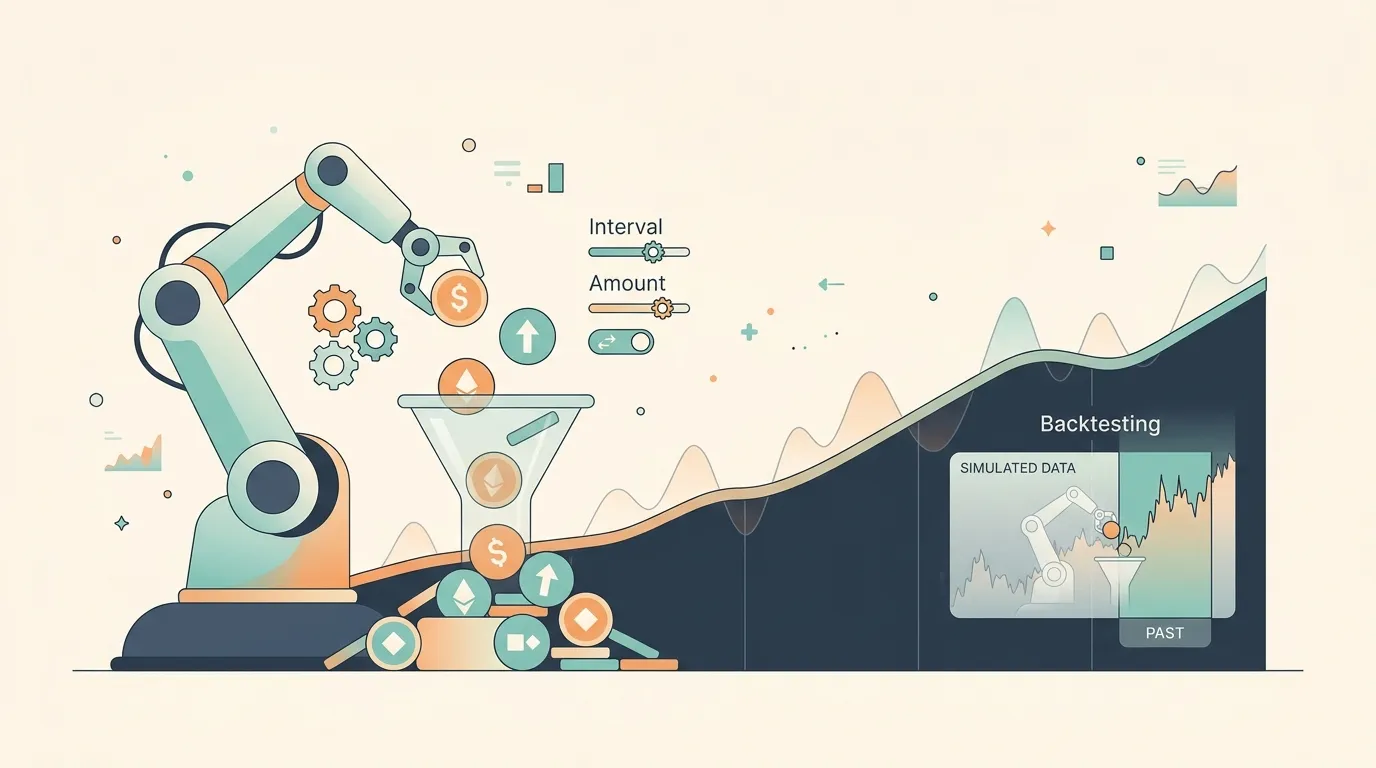
Crypto DCA Bot Strategy: A Practical Configuration Guide
Learn how a crypto DCA bot strategy works, which parameters to configure, how to backtest on historical data, and what risk controls to apply before trading live.
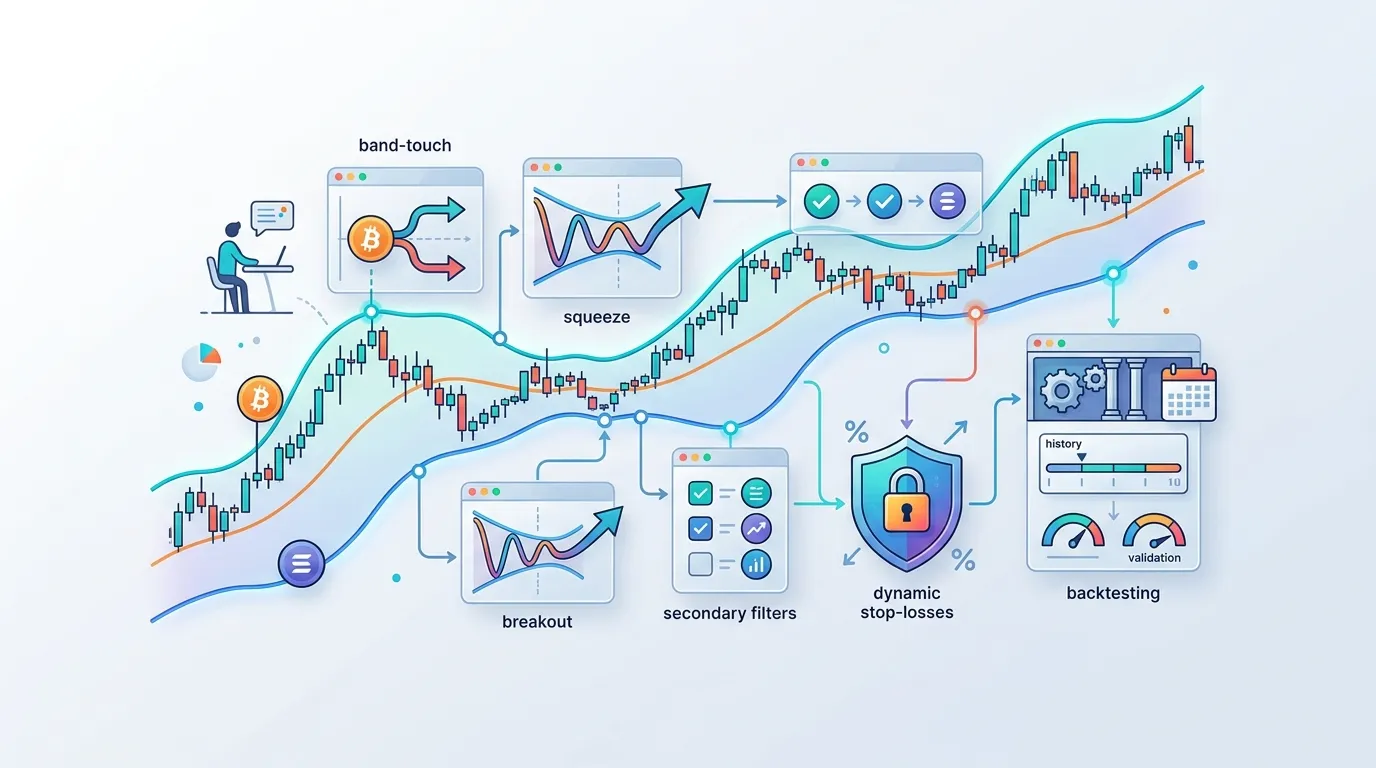
Bollinger Bands Crypto Trading Bot: A Practical Setup Guide
Learn how to configure a Bollinger Bands crypto trading bot with band-touch and squeeze-breakout logic, secondary filters, dynamic stop-losses, and backtesting to validate your setup before going live.