Crypto Grid Trading Bot: A Complete Setup Guide for 2025
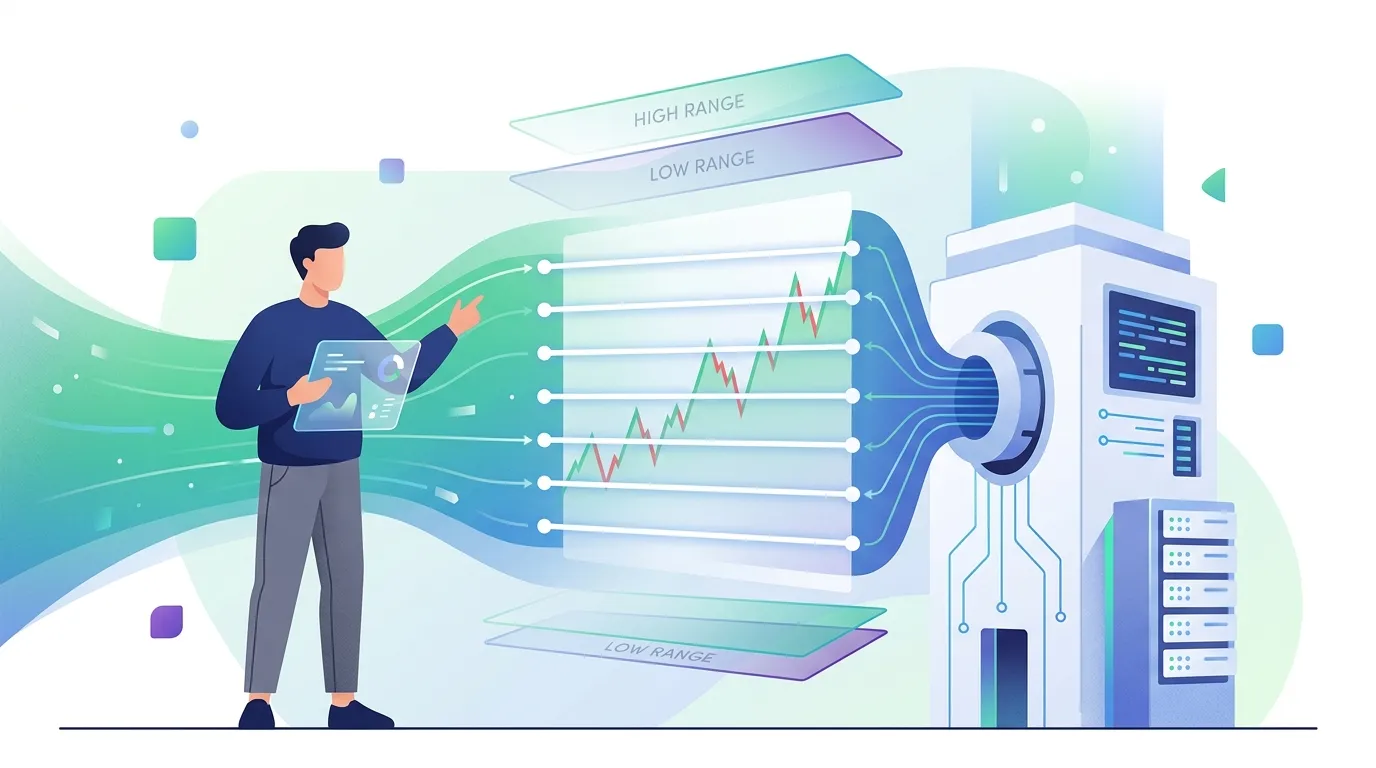
Grid trading is one of the oldest algorithmic strategies in financial markets — and in crypto, where coins can oscillate 3–8% in a single session without establishing a clear trend, it has found a natural home. This guide explains exactly how a crypto grid trading bot works, walks through every configuration parameter that matters, and shows how to go from strategy idea to deployed tool using Cryptohopper.AI without writing a line of code.
What Is a Crypto Grid Trading Bot and How Does It Work?
A crypto grid trading bot is an automated system that places a pre-defined ladder of buy and sell limit orders at evenly spaced price intervals — called "grid levels" — within a set price range. When the price drops to a buy level, the bot fills that order; when it rebounds to the corresponding sell level above it, the bot closes the position for a small profit. This cycle repeats continuously, harvesting gains from every oscillation.
The core mechanic is simple: divide a price range (say, $28,000–$34,000 for BTC/USDT) into N equal intervals. Place a buy order at each lower boundary and a sell order at each upper boundary. Every round-trip between adjacent levels generates a small, roughly equal profit. Over hundreds of cycles in a sideways market, those small gains compound into meaningful returns — without predicting price direction at all.
"Grid bots don't need to know where the price is going — they just need it to keep moving back and forth within a range."
Key Configuration Parameters for a Grid Bot
Getting the parameters right is where strategy meets execution. Here are the five values every grid bot setup requires:
- Upper price bound — The highest price at which the bot will place a sell order. Orders above this level are ignored. Set this at a realistic resistance level, not a wishful ceiling.
- Lower price bound — The lowest price at which the bot will place a buy order. Setting this too close to the current price risks rapid fill without a recovery bounce; too far away and grid density suffers.
- Number of grid levels (N) — More levels mean smaller profit per trade but more frequent fills. Fewer levels mean larger per-trade profit but longer waits. A typical range is 5–50 levels. For a $6,000 range with 20 levels, each grid interval is $300.
- Order size per grid — The amount of base or quote currency allocated to each buy order. This directly controls your position size and total capital commitment. Total capital ≈ lower bound × order size × N (for a purely quote-denominated grid).
- Base currency / quote currency — Whether orders are denominated in the asset (e.g., 0.01 BTC per grid) or the quote (e.g., $50 USDT per grid). Quote-denominated grids are simpler to size for risk management purposes.
Arithmetic vs. Geometric Grids
An arithmetic grid spaces levels by a fixed dollar amount ($300 apart). A geometric grid spaces levels by a fixed percentage (1.5% apart). Geometric grids are better for wider ranges because they keep profit percentages constant regardless of price level — a $300 interval at $29,000 is ~1%, but only ~0.88% at $34,000.
Grid Trading vs. DCA vs. Signal-Based Strategies
Understanding where grid trading fits helps you choose the right tool for market conditions.
| Strategy | Best Market Condition | Profit Driver | Requires Prediction? |
|---|---|---|---|
| Grid trading | Ranging / sideways | Price oscillation within range | No |
| DCA (dollar-cost averaging) | Long-term uptrend | Lower average entry cost | Partially (bullish bias) |
| Signal/indicator bot (RSI, MACD) | Trending or volatile | Catching directional moves | Yes |
Grid bots thrive in choppy, mean-reverting conditions. A DCA bot is better suited when you have a long-term bullish thesis on an asset and want to build a position gradually. Signal-based bots using RSI or MACD indicators are designed to ride directional momentum — exactly the condition in which a grid bot can bleed capital if the price breaks out of range and keeps going.
"Choosing the wrong strategy for the market regime is the most common mistake automated traders make. Know your market structure first."
Is Grid Trading Profitable in Crypto Markets?
Grid trading can be profitable in ranging markets, but it carries real risks that every trader must understand. In a sustained uptrend or downtrend, a grid bot may accumulate a growing unrealized loss on the "wrong side" of the market — buying a falling asset repeatedly without the sell orders ever filling. Profitability depends on range accuracy, grid density, fee levels, and market volatility. Crypto trading carries substantial risk of loss, and past performance of any strategy is not indicative of future results.
How Do You Set Up a Grid Trading Bot for Cryptocurrency?
Step 1 — Define Your Price Range
Study the asset's recent price history (30–90 days). Identify clear horizontal support and resistance. Your lower bound should sit near a tested support level; your upper bound near tested resistance. Avoid ranges wider than the asset's historical volatility can realistically fill within your intended holding period.
Step 2 — Choose Grid Density and Order Size
A good starting heuristic: use 10–20 grid levels for a new strategy. Calculate total capital commitment (order size × N) and ensure it represents a position size you're comfortable holding at the lower bound. Never allocate more than you can afford to lose.
Step 3 — Set a Stop-Loss for Range Breaks
This is the most overlooked parameter. If the price closes decisively below your lower bound, the grid is broken and the bot will keep buying a falling asset. Configure a stop-loss (either at the lower bound or a fixed percentage below it) to exit the position and preserve remaining capital.
Step 4 — Build It with Cryptohopper.AI
Rather than coding a grid bot from scratch, you can describe what you want in plain English at Cryptohopper.AI. For example: "Build a grid trading bot for BTC/USDT with 15 grid levels between $28,000 and $34,000, $50 USDT per grid, using my Cryptohopper account, and display a P&L dashboard with realized/unrealized gains and fill rate." The platform generates the code, connects to your Cryptohopper account via OAuth, and deploys the tool automatically to a <project>.cryptohopper.app subdomain — no manual deployment step required. Project secrets like API keys are encrypted at rest and never exposed in generated code.
What Are the Risks of Using a Grid Trading Bot?
- Trend risk — A strong directional move outside your range can cause large unrealized losses. A grid bot is not a hedge; it is a range-bound tool.
- Fee erosion — With many small trades, exchange fees accumulate quickly. At 0.1% per trade, 500 fills per month = 50% of gross profit consumed by fees at low grid margins. Always calculate net profit after fees.
- Capital lock-up — All grid levels tie up capital simultaneously. In a broken range, that capital may be difficult to redeploy quickly.
- Over-optimization — A range that looks perfect on historical data may not reflect future volatility regimes. Back-test with out-of-sample data when possible.
How to Interpret Your Grid Bot's P&L Dashboard
A well-built grid bot dashboard should surface at least four metrics:
- Realized P&L — Profit from completed buy-sell round trips. This is cash in hand and the most reliable performance indicator.
- Unrealized P&L — Open position value versus average entry cost. A large negative unrealized P&L signals the price has drifted toward your lower bound — time to review your range.
- Fill rate — The percentage of placed grid orders that have been filled. A fill rate below 30% may mean your range is too wide or the market is trending away.
- Grid efficiency — Realized P&L ÷ maximum capital deployed. This normalizes performance relative to how much capital the strategy consumed, enabling apples-to-apples comparison across different configurations.
"Realized P&L tells you what you've earned. Grid efficiency tells you whether it was worth the capital tied up to earn it."
Track these metrics over rolling 7-day and 30-day windows to distinguish signal from noise in volatile markets.
What Is the Difference Between Grid Trading and Regular Crypto Trading?
Regular (discretionary or signal-based) crypto trading involves making directional bets — buying because you expect the price to rise, selling because you expect it to fall. Grid trading makes no directional assumption at all. It profits from volatility itself, regardless of whether the short-term trend is up or down, as long as the price stays within the defined range. This makes grid bots genuinely market-neutral within their range, which is a meaningful structural difference from most other automated strategies.
Wrapping Up
A crypto grid trading bot is a powerful, systematic way to harvest profit from sideways price action — but it demands careful configuration and honest risk management. Define a realistic price range, calibrate grid density to your capital and fee structure, and always deploy a stop-loss for range-break scenarios. If you want to skip the coding and go straight to a working, deployed grid bot, Cryptohopper.AI lets you describe your strategy in plain language and generates the tool automatically — including a P&L dashboard — on top of your existing Cryptohopper account.
Crypto trading involves significant financial risk. Nothing in this article constitutes investment or trading advice.
Frequently asked questions
What is a crypto grid trading bot and how does it work?
A crypto grid trading bot places a ladder of buy and sell limit orders at evenly spaced price intervals within a defined range. When the price drops to a buy level, the bot fills the order; when it rebounds to the sell level above, it closes the position for a small profit. This cycle repeats continuously, generating gains from price oscillation without requiring any directional price prediction.
Is grid trading profitable in crypto markets?
Grid trading can be profitable in ranging, sideways markets where price oscillates repeatedly within a defined band. However, it carries significant risks — particularly in trending markets, where the price may break out of range and cause growing unrealized losses. Profitability depends on range accuracy, number of grid levels, exchange fees, and market conditions. Crypto trading involves substantial risk of loss, and no strategy guarantees returns.
What are the best crypto grid trading bots available?
Several platforms offer grid trading functionality, including Cryptohopper (cryptohopper.com), which provides a dedicated grid bot product with exchange integrations. Cryptohopper.AI (cryptohopper.ai) is an AI builder that lets you describe and generate a custom grid trading tool in plain language, deployed automatically without coding. The 'best' bot depends on your exchange, preferred configuration flexibility, and whether you want a ready-made solution or a customized tool.
What are the risks of using a grid trading bot?
Key risks include: trend risk (a strong directional move outside your range can create large unrealized losses), fee erosion (many small trades accumulate significant exchange fees), capital lock-up (all grid levels tie up funds simultaneously), and over-optimization (a range that worked historically may not hold in future market conditions). Always set a stop-loss at or near your lower price bound to limit downside if the range breaks.
How do you set up a grid trading bot for cryptocurrency?
To set up a crypto grid trading bot: (1) Identify a realistic price range using support and resistance levels from recent price history. (2) Choose a grid density (typically 10–20 levels) and calculate order size per grid based on total capital you're willing to deploy. (3) Set a stop-loss below the lower bound to protect against range breaks. (4) Configure and deploy the bot — or use a platform like Cryptohopper.AI to describe the strategy in plain language and have the tool generated and deployed automatically.
Subscribe to the Cryptohopper newsletter
New posts, product updates, and the occasional lesson — straight to your inbox.
We'll never share your email. Unsubscribe anytime.
Related articles

DCA Crypto Trading Bot: How It Works and How to Build One
Learn how a DCA crypto trading bot automates dollar-cost averaging, how to configure intervals, order sizes, and safety orders, and how to build a custom DCA bot without writing code.
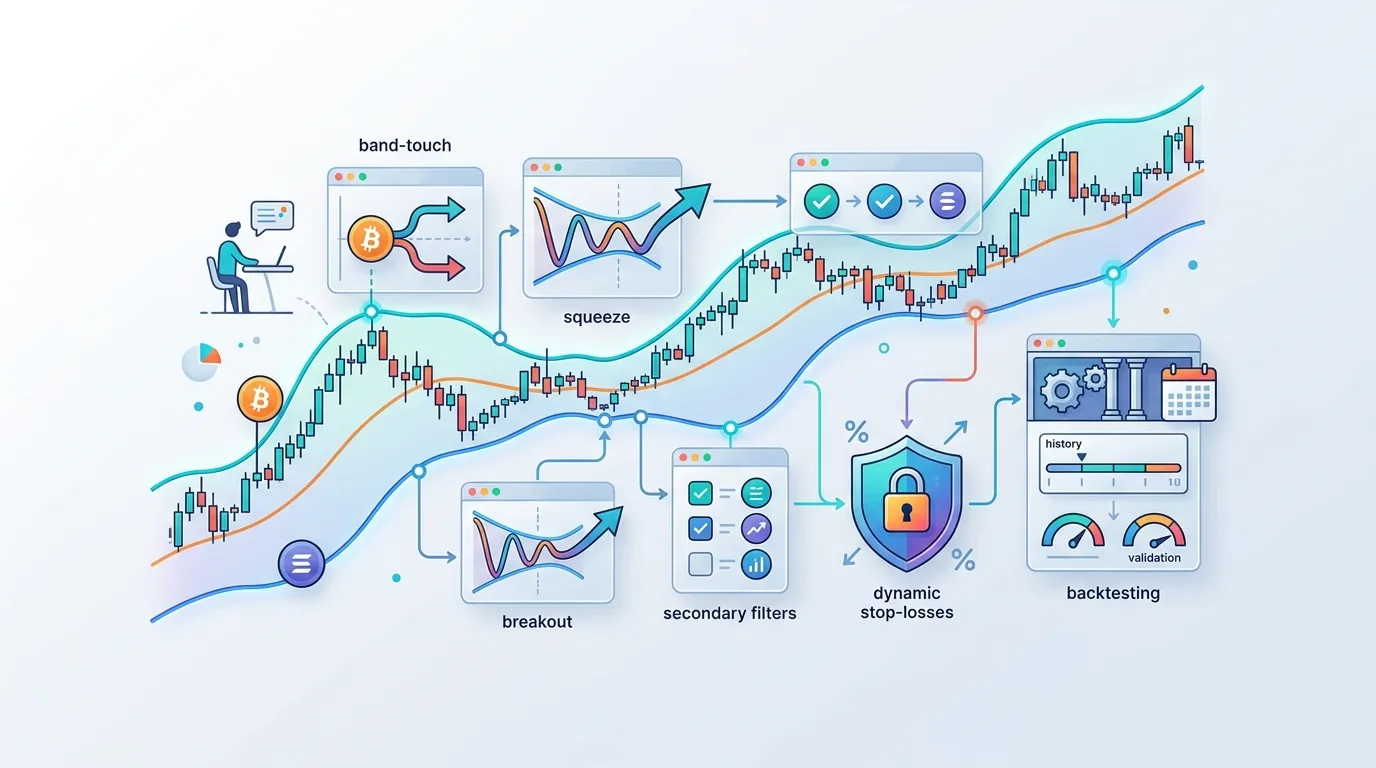
Bollinger Bands Crypto Trading Bot: A Practical Setup Guide
Learn how to configure a Bollinger Bands crypto trading bot with band-touch and squeeze-breakout logic, secondary filters, dynamic stop-losses, and backtesting to validate your setup before going live.

Crypto Grid Trading Bot: A Complete Setup Guide
Learn how a crypto grid trading bot works, how to configure price ranges and grid levels, and how to deploy one without writing a single line of code using an AI builder.