Crypto Grid Trading Bot: A Complete Setup Guide

If you've watched a crypto asset bounce between the same support and resistance levels for weeks, you've witnessed the exact market condition a crypto grid trading bot is designed to exploit. This guide breaks down exactly how grid bots work, how to configure every important parameter, and how to deploy one without touching a single line of code.
What Is a Crypto Grid Trading Bot and How Does It Work?
A crypto grid trading bot is an automated system that places a series of evenly spaced buy and sell limit orders across a defined price range. When price drops to a buy level, the bot purchases; when it rebounds to the next sell level, the bot sells. Each round trip — buy low, sell slightly higher — captures a small profit. Repeated hundreds of times across a ranging market, those small gains accumulate. The bot requires no price-direction prediction; it simply harvests the volatility already present in the market.
Here's the mechanical loop in plain terms:
- You define an upper bound (e.g., $35,000) and a lower bound (e.g., $28,000) for a trading pair like BTC/USDT.
- The bot divides that range into N grid levels — say, 10 levels spaced $700 apart.
- At each level below the current price, the bot places a buy limit order. At each level above, it places a sell limit order.
- When a buy fills, a corresponding sell is automatically placed one grid step higher. When that sells, the profit is locked and the cycle repeats.
"Grid trading doesn't need to know where price is going — only that it will keep moving. Volatility is the fuel; the grid is the engine."
Key Configuration Parameters for a Grid Bot
Getting your grid configured correctly is the single biggest factor separating a well-performing bot from one that bleeds capital. Here are the core parameters to understand:
Upper and Lower Price Bounds
These define the arena your bot operates in. Set them too tight and the bot runs out of room; too wide and your grid steps become so large that individual trades capture barely any spread. A practical starting point is to look at 30–90 days of historical price action and choose bounds that contain roughly 80% of that range.
Number of Grid Levels
More levels mean smaller spacing between orders, which means more frequent trades but smaller profit per trade. Fewer levels mean larger spacing and larger per-trade profit, but fewer fills. A common range for mid-cap pairs is 10–25 levels. Compute the per-grid profit by dividing the total range by the number of levels and dividing that by the lower bound — this gives you the approximate percentage gain per completed cycle.
Per-Order Size
This is how much capital each individual buy or sell order uses. Multiply per-order size by the number of grid levels to estimate your total capital commitment. Never allocate more than you can afford to see locked in open orders for an extended period.
Base vs. Quote Allocation
A grid bot can be initialized in two ways:
- Quote-only (e.g., USDT only): The bot starts fully in stablecoin and places only buy orders below the current price. Lower risk, but you miss potential fills above entry.
- Mixed (base + quote): You split capital between, say, BTC and USDT. The bot places both buys below and sells above immediately, maximizing grid coverage from the start.
Is Grid Trading Profitable in Crypto Markets?
Grid trading can generate consistent small gains in sideways or range-bound markets, where price oscillates without a strong directional trend. Crypto assets — especially large-caps like BTC and ETH — frequently spend extended periods consolidating in ranges, making grid bots a relevant tool for those conditions. However, profitability is never guaranteed. Exchange fees, slippage, and breakout events all erode returns, and markets can trend against a grid's range for weeks. Grid trading is a strategy with defined mechanics — not a guarantee of income. Always account for worst-case scenarios in your configuration.
Grid Trading vs. DCA Bots: Which Fits Your Market?
These two strategies are often confused because both automate recurring buy orders, but they operate on fundamentally different logic.
| Feature | Grid Trading Bot | DCA Bot |
|---|---|---|
| Best market condition | Sideways / range-bound | Trending (upward) |
| Order logic | Ladder of buys and sells across a fixed range | Periodic buys at fixed intervals or price dips |
| Profit mechanism | Spread captured on each round-trip cycle | Average cost basis lowered over time |
| Direction requirement | None — profits from oscillation | Benefits from eventual upward price movement |
| Capital usage | Locked across all grid levels | Deployed incrementally |
| Risk on breakout | Significant if price exits range downward | Continues buying (can lower avg cost further) |
Use a grid bot when you believe an asset will consolidate in a range. Use a DCA bot when you have a longer time horizon and want to accumulate an asset regardless of short-term volatility. Many traders run both simultaneously on different pairs.
"Grid and DCA bots aren't competitors — they're complements. Grid extracts value from sideways chop; DCA builds positions through trends."
How Do You Set Up a Grid Trading Bot for Cryptocurrency?
Setting up a crypto grid trading bot traditionally required programming knowledge or learning a complex platform UI. With AI builders, the workflow is significantly simpler. Here's a general step-by-step approach:
- Choose your pair and timeframe. Analyze recent price history to identify a plausible trading range.
- Define your parameters. Set upper bound, lower bound, number of levels, and per-order size.
- Decide your capital allocation. Determine how much USDT (or your quote currency) to commit and whether to start with a mixed base/quote position.
- Connect your exchange. Most grid bots run through an exchange API — your keys authorize the bot to place orders on your behalf.
- Set safety conditions. Define stop-loss triggers for if price breaks below your lower bound, and optionally a take-profit trigger if it breaks above your upper bound.
- Monitor and iterate. Review filled orders, realized P&L, and adjust range or grid count as market conditions evolve.
With Cryptohopper.AI, you describe this entire configuration in plain language — for example: "Build a grid trading bot for BTC/USDT with a range of $28,000 to $35,000, 15 grid levels, and $200 per order" — and the platform generates and deploys the bot automatically to a live yourproject.cryptohopper.app subdomain. No code writing, no manual deployment step. The tool connects to your Cryptohopper account via OAuth so your exchange credentials are handled securely, with secrets encrypted at rest and injected at runtime. You can also prompt it to generate a companion portfolio dashboard showing open grid orders, realized P&L, and filled trade history alongside the bot itself.
What Are the Risks of Using a Grid Trading Bot?
Grid bots carry specific, well-defined risks that every user should understand before deploying capital.
Price Breakout Below the Lower Bound
If price falls below your lower bound, all your buy orders have filled but no sells have triggered. You're now holding a full bag of the base asset at a loss with no bot activity. This is sometimes called "going to zero grid" — the bot has nothing left to do except wait.
Mitigation: Set a hard stop-loss below your lower bound. Some implementations auto-cancel all open orders and liquidate if price crosses a threshold.
Price Breakout Above the Upper Bound
If price surges above your upper bound, all sell orders fill and you're left holding only the quote asset (e.g., USDT). You've sold all your base asset and miss the continued rally.
Mitigation: Set a take-profit that closes the grid and optionally enters a trend-following position above the range.
Exchange Fees
High-frequency grids on pairs with wide spreads or high taker fees can turn grid profits negative. Calculate your break-even spread (grid step size minus round-trip fee) before committing capital.
Opportunity Cost
Capital locked in a grid range is capital not available for other trades. If the asset trends sharply in either direction, a grid bot typically underperforms compared to simply holding or riding the trend.
Monitoring Your Grid Bot with a Portfolio Dashboard
A grid bot running in isolation is difficult to evaluate without real-time visibility into its activity. A well-designed companion dashboard should surface:
- Open grid orders — how many buys and sells are currently live and at what price levels
- Filled trade history — a log of every completed buy/sell cycle with timestamps
- Realized P&L — total profit locked in from completed cycles, net of fees
- Unrealized position — current value of the base asset held due to unfilled sell orders
When using Cryptohopper.AI, you can prompt it to generate this dashboard as a separate project or as a panel within the same app. Describing what you want in plain language — "Show a table of all open grid orders and a chart of realized P&L over time" — produces a deployed, shareable interface without manual front-end development.
Wrapping Up
A crypto grid trading bot is one of the most mechanically transparent strategies in automated trading: place a ladder of orders, collect the spread, repeat. Success depends on disciplined parameter configuration, honest assessment of market conditions, and clear risk boundaries for when price exits your range. No bot eliminates risk — but a well-configured grid bot gives you a structured, rules-based way to participate in range-bound markets. If you want to build and deploy one without writing code, Cryptohopper.AI lets you describe your strategy in plain language and handles the rest automatically.
Frequently asked questions
What is a crypto grid trading bot and how does it work?
A crypto grid trading bot places a series of evenly spaced buy and sell limit orders across a defined price range. When price dips to a buy level, the bot buys; when it rises to the next sell level, the bot sells. Each completed round trip captures a small profit from the price oscillation. The bot repeats this process automatically, accumulating gains without needing to predict price direction — it simply profits from volatility within the range.
Is grid trading profitable in crypto markets?
Grid trading can generate consistent gains in sideways or range-bound markets, where crypto assets oscillate between support and resistance levels without a strong directional trend. However, profitability is not guaranteed. Exchange fees, slippage, and breakout events — where price exits the configured range — can erode or eliminate returns. Grid trading is a defined strategy with clear mechanics, not a guaranteed income source. Risk management and correct range configuration are critical to its performance.
What are the best crypto grid trading bots available?
Several platforms offer grid trading bot functionality, including Cryptohopper (cryptohopper.com), 3Commas, and exchange-native tools on Binance and Bybit. The best choice depends on your exchange, technical comfort level, and how much customization you need. For traders who want to build a fully custom grid bot without coding, Cryptohopper.AI (cryptohopper.ai) lets you describe your strategy in plain language and auto-deploys the bot — giving you more flexibility than fixed templates.
What are the risks of using a grid trading bot?
The primary risks are price breakouts outside the configured range. If price falls below the lower bound, all buy orders fill but no sells trigger, leaving you holding a losing position. If price rises above the upper bound, all sells execute and you miss the upward rally. Additionally, high-frequency grids can be eroded by exchange fees if the per-grid profit margin is too small. Always set stop-loss conditions below your lower bound and calculate your break-even spread before deploying capital.
What is the difference between grid trading and DCA bots?
Grid trading bots place a fixed ladder of buy and sell orders within a range, profiting from price oscillating back and forth — no directional trend is needed. DCA (Dollar-Cost Averaging) bots make periodic buys at set intervals or on price dips, gradually building a position at a lower average cost. Grid bots are best in sideways markets; DCA bots suit trending markets where you want to accumulate an asset over time. Both strategies carry risk and neither guarantees profit.
Subscribe to the Cryptohopper newsletter
New posts, product updates, and the occasional lesson — straight to your inbox.
We'll never share your email. Unsubscribe anytime.
Related articles
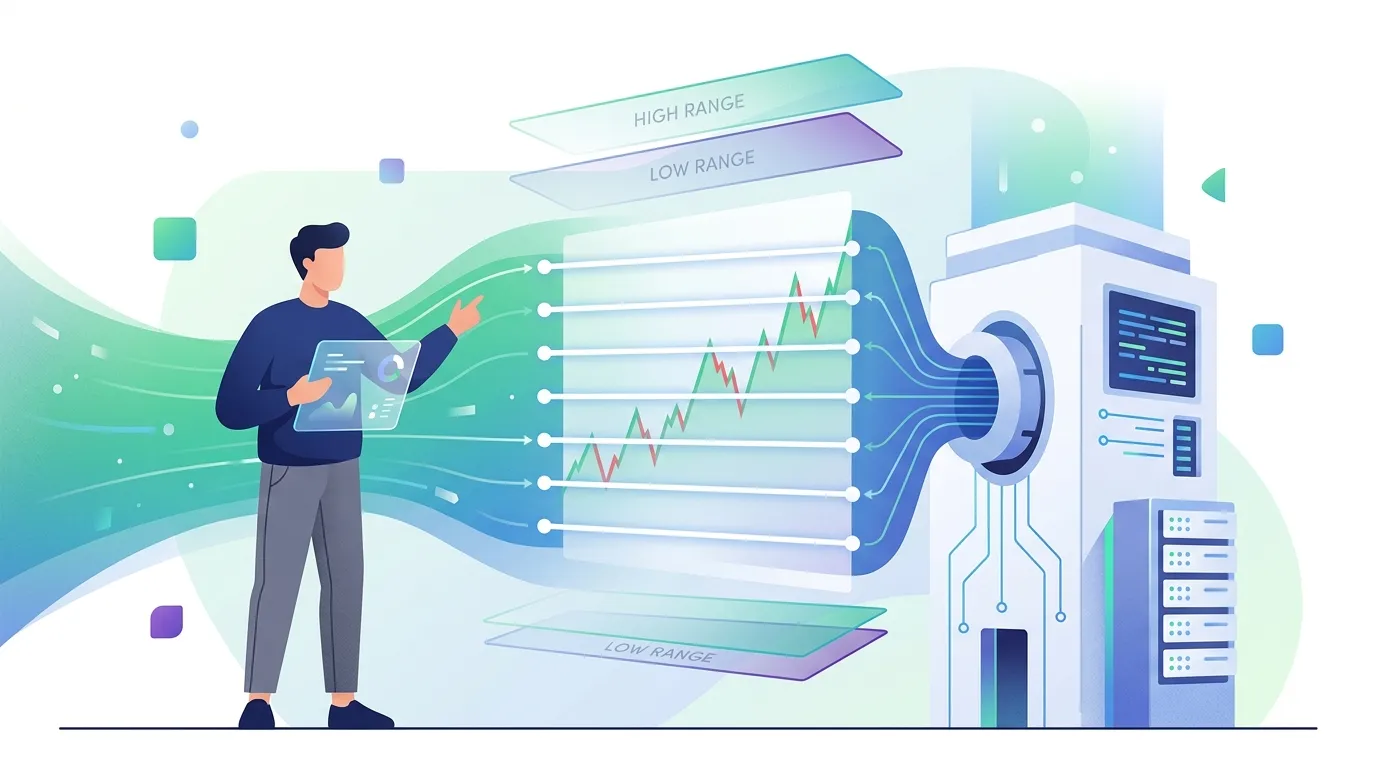
Crypto Grid Trading Bot: A Complete Setup Guide for 2025
Learn how a crypto grid trading bot works, how to configure price ranges and grid levels, and how to build and deploy one using Cryptohopper.AI — no coding required.

DCA Crypto Trading Bot: A Complete Builder's Guide
Learn how a DCA crypto trading bot works, which parameters matter most, how to set smart entry conditions, and how to build and deploy one using plain-language AI tools.
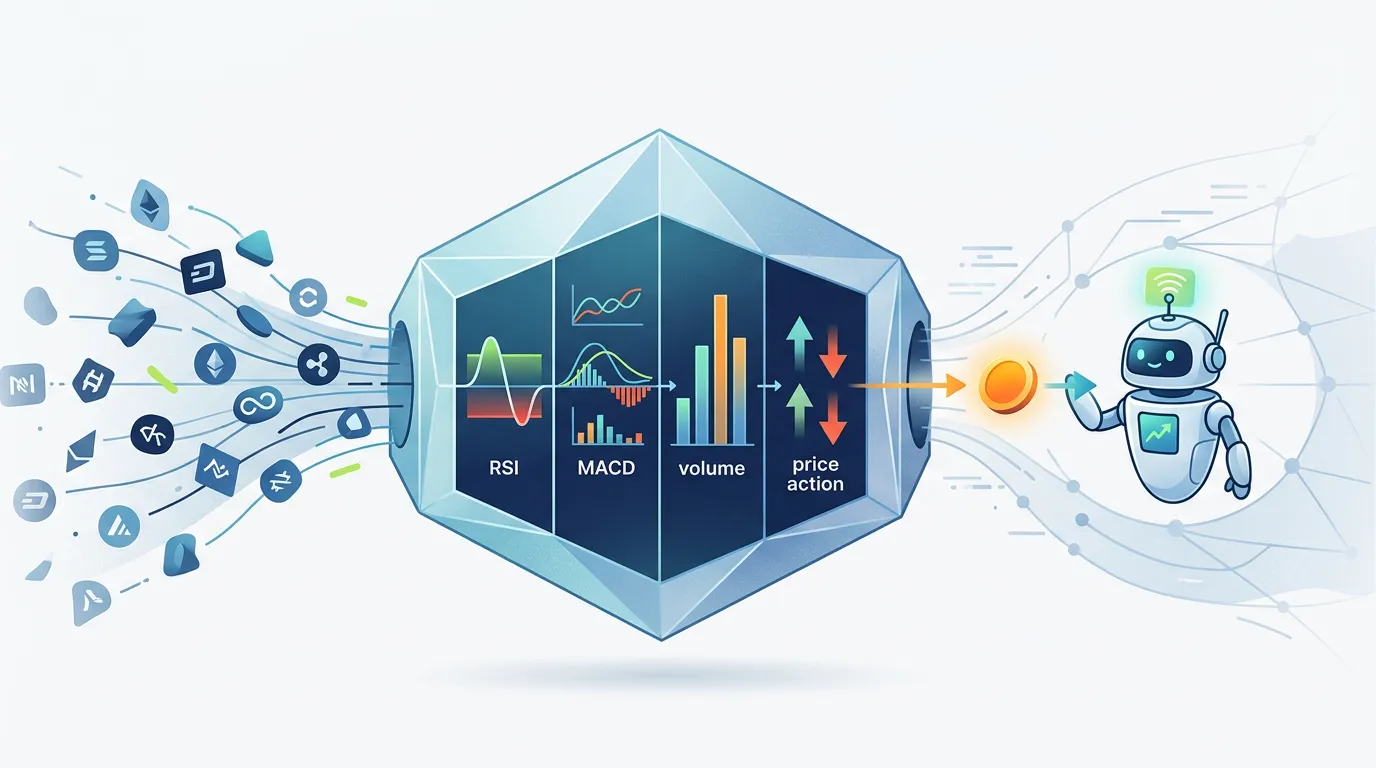
Crypto Market Screener for Trading Bots: A Practical Build Guide
Learn how to build a custom crypto market screener that filters assets by RSI, MACD, volume, and price action to surface clean bot entry signals before automated orders fire.