Crypto DCA Bot Strategy: A Practical Configuration Guide
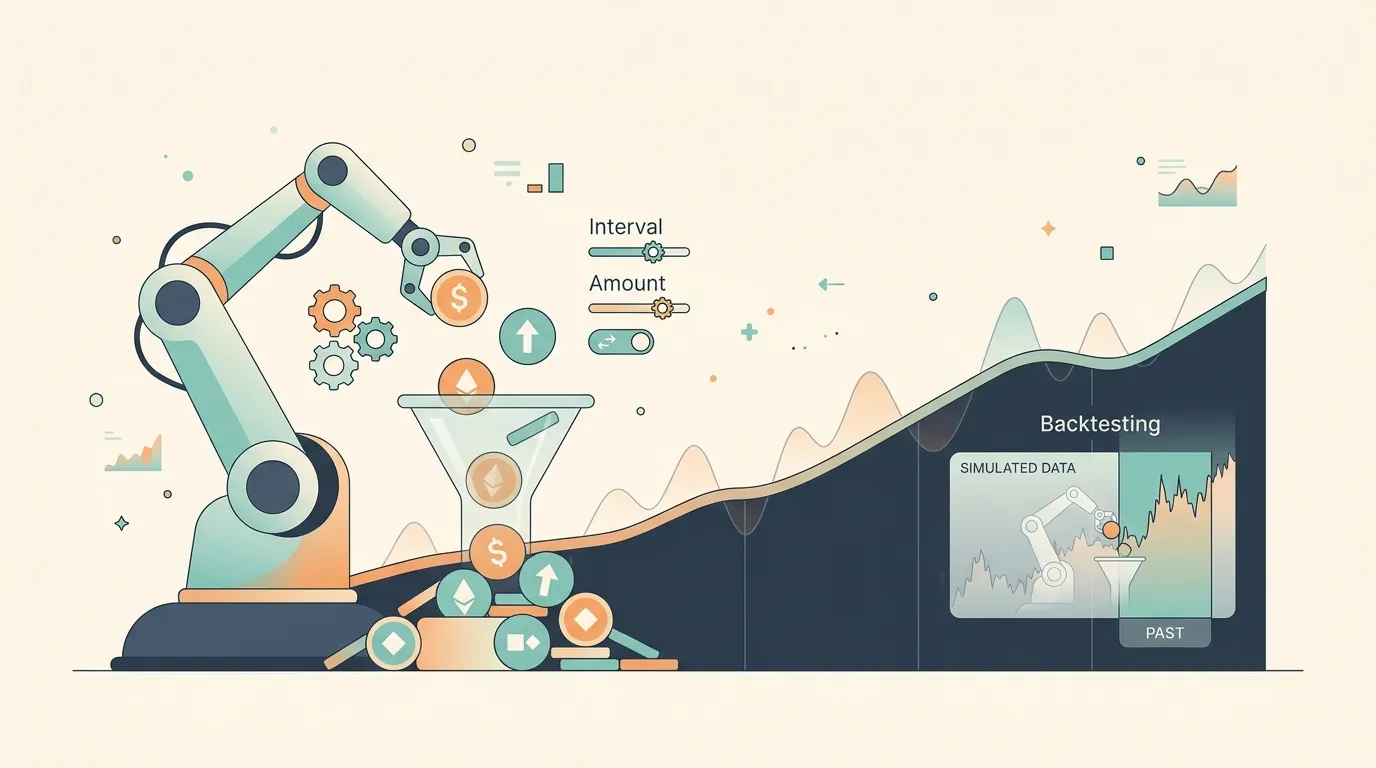
Running a disciplined dollar-cost averaging plan manually is harder than it sounds — you miss a scheduled buy, second-guess a dip, or simply forget. A crypto DCA bot strategy solves that by automating every entry, every safety order, and every take-profit target with zero emotional interference. This guide walks through how DCA bots work under the hood, which parameters actually matter, and how to validate your configuration with backtesting before a single dollar of real capital is at risk.
What Is a DCA Bot and How Does It Work in Crypto?
A DCA (Dollar-Cost Averaging) bot is an automated trading program that buys a fixed dollar amount of a cryptocurrency at regular intervals or at predefined price-drop thresholds. Instead of trying to time the market, it spreads purchases across multiple price levels, lowering the average cost per coin over time. Most implementations combine a base order (the first buy) with a series of safety orders (additional buys triggered when price falls further), then closes the full position once a take-profit target is reached.
Dollar-cost averaging does not guarantee a profit or protect against loss in a declining market — it is a method of smoothing entry prices over time, not a prediction of future performance.
Why Bots Outperform Manual DCA Execution
Manual DCA works in theory but breaks down in practice for three reasons:
- Timing discipline — A bot executes at the exact scheduled moment; humans sleep, travel, or hesitate.
- Speed on dips — Safety orders must fire quickly during sharp drops. A bot reacts in milliseconds; a manual trader may miss the window entirely.
- Consistency at scale — Running DCA across five or ten trading pairs simultaneously is trivially easy for a bot and operationally impossible by hand.
Automation also removes the behavioral biases — panic selling during a drawdown, or skipping a buy because a coin "looks scary" — that routinely undermine long-term averaging strategies.
Breaking Down the Core DCA Bot Parameters
Understanding each parameter prevents misconfiguration that can turn a sensible strategy into runaway risk.
Base Order Size
The initial buy amount when a new deal opens. Keep this modest relative to your total allocation — it should leave room for safety orders to follow.
Safety Orders
Additional buy orders placed at lower price levels if the market moves against your position. Key sub-parameters:
- Safety order size — usually a fixed dollar amount or a multiplier of the base order (e.g., 1.5× each subsequent order).
- Price deviation per safety order — how many percent below the previous buy the next order triggers (e.g., 2.5%).
- Safety order step scale — increases the price gap between successive safety orders, which preserves capital as drawdowns deepen.
- Maximum safety order count — the hard cap on how many extra buys you'll make, capping total exposure per deal.
Take-Profit Target
The percentage gain above your average entry price (not the base order price) at which the bot closes the entire deal. Because safety orders lower your average cost, even a modest recovery can hit the take-profit threshold.
Deal Start Condition
What triggers the base order: a time interval (e.g., every 4 hours), a price signal (RSI below 30), or a manual start. Signal-based starts can reduce the frequency of deals opened into strong downtrends.
How to Backtest a DCA Bot Configuration on Historical Data
Backtesting replays your parameter set against historical candle data to answer three critical questions:
- How often did safety orders trigger? If all 10 safety orders fired on nearly every deal, your price deviation step is too tight or the asset is more volatile than your capital can absorb.
- What was the resulting average entry price? A good configuration brings average cost meaningfully below the initial entry.
- What was the maximum capital drawdown per deal? Multiply base order + all safety order sizes at their trigger levels — this is your worst-case capital commitment per pair.
A practical backtesting workflow:
- Select a representative historical window — ideally one that includes both a trending period and a sideways/corrective period (e.g., 6–12 months of daily candles).
- Run the configuration and record: number of completed deals, average deal duration, take-profit hit rate, and maximum simultaneous capital deployed.
- Adjust deviation steps or safety order count until the capital commitment per deal fits within your risk tolerance, then re-run.
- Test on a different historical period to check for overfitting — parameters that only "work" on the exact window you tuned them on are unreliable.
A backtest is a simulation, not a guarantee. Past price behavior does not predict future results. Use backtesting to identify obviously broken configurations, not to forecast returns.
Is Dollar-Cost Averaging a Good Strategy for Cryptocurrency?
DCA is widely considered one of the more disciplined approaches to accumulating a volatile asset class because it removes the need to predict price tops and bottoms. In crypto, where 30–50% drawdowns are historically common even in broadly rising markets, spreading entries across price levels can reduce the emotional cost of timing mistakes. However, DCA does not eliminate loss risk — in a sustained bear market, every safety order adds to a losing position. Maximum safety order count and stop-loss limits exist precisely to cap that downside.
Risk-Management Layering for DCA Bots
A DCA configuration without explicit risk controls can consume your entire account during a prolonged drawdown. Layer these controls:
- Stop-loss per deal — closes a deal at a hard loss limit (e.g., −25% of average entry) before safety orders are exhausted. Painful, but prevents catastrophic exposure.
- Maximum open deals — limits how many DCA deals run simultaneously, preventing your bot from opening new positions on multiple pairs while existing ones are deep in drawdown.
- Total budget allocation — pre-calculate the maximum capital required if every safety order on every open deal fires at once. Your allocated budget should cover this without borrowing or margin.
- Deal cooldown — a waiting period after a deal closes before a new one opens on the same pair, preventing rapid re-entry into a collapsing asset.
What Are the Risks of Using a Crypto DCA Bot?
The main risks are:
- Runaway capital commitment — poorly configured safety orders can commit far more capital than intended during a sharp, prolonged decline.
- Take-profit never reached — in a long bear market, the price may not recover to your average entry + take-profit % within any reasonable timeframe.
- Exchange/API failure — connectivity issues can leave open positions unmanaged.
- Over-optimization — backtests tuned too precisely on historical data may fail on live markets.
- Security — hardcoded API keys in bot scripts are a major attack surface; use a platform that encrypts secrets at rest and injects them at runtime.
How Often Should a DCA Bot Buy Crypto for Best Results?
There is no universally optimal frequency — it depends on your asset, volatility regime, and capital size. Common configurations:
| Frequency | Best Suited For | Consideration |
|---|---|---|
| Every 4–12 hours | Active traders, smaller positions | Higher transaction costs |
| Daily | Mid-range volatility assets | Balances cost and responsiveness |
| Weekly | Long-term accumulators | Lower fees, less noise |
| Price-deviation only | Any, signal-driven | Fires only on meaningful dips |
Price-deviation-only deals (no fixed interval) tend to be more capital-efficient because they only open when price has actually moved. Fixed-interval deals run regardless of market conditions, which increases the risk of opening into an already-extended downtrend.
Building a DCA Bot with Cryptohopper.AI
Once you have a validated configuration, implementation is the next step. Cryptohopper.AI lets you describe the DCA bot you want in plain language — safety order count, deviation steps, take-profit logic, stop-loss rules — and generates the code for you, no manual coding required. Projects are deployed automatically to a hosted <project>.cryptohopper.app subdomain; there is no separate deploy step. Exchange API keys are encrypted at rest with KMS and injected securely at runtime, so they never appear in generated code or logs. Users connect via their Cryptohopper account (cryptohopper.com), and every subscription plan includes AI Credits to build and iterate.
Paper Trading: The Final Validation Step Before Live Capital
Backtesting uses historical data; paper trading runs your live configuration against real-time market prices with simulated funds. This catches problems backtesting cannot: API latency, order book slippage, and edge cases in deal-start logic that only appear during live market hours. Run your configuration in paper-trading mode for at least two to four weeks — long enough to observe at least a few safety order sequences and completed deals — before switching to live capital. If the paper results differ significantly from your backtest expectations, revisit the configuration before risking real funds.
Wrapping Up
A well-configured crypto DCA bot strategy automates the discipline that manual trading consistently fails to maintain. Define your base order, set deliberate safety order parameters, and validate the configuration against multiple historical periods before touching live capital. Layer stop-loss limits and maximum open deal counts to cap worst-case exposure. Use paper trading as the final sanity check. Crypto markets carry substantial risk of loss — systematic tools reduce behavioral errors, but they do not eliminate market risk.
Frequently asked questions
What is a DCA bot and how does it work in crypto?
A DCA (Dollar-Cost Averaging) bot automatically buys a fixed dollar amount of a cryptocurrency at regular intervals or when price drops by a set percentage. It opens with a base order, places additional safety orders as price falls to lower the average entry cost, and closes the full position when a take-profit target above the average entry price is reached.
Is dollar-cost averaging a good strategy for cryptocurrency?
DCA is widely regarded as a disciplined approach to accumulating volatile assets because it removes the need to time market tops and bottoms. In crypto, where large drawdowns are historically common, spreading entries across price levels can reduce the impact of poor timing. However, it does not eliminate loss risk — in a sustained downtrend, safety orders add to a losing position, which is why maximum order counts and stop-loss limits are essential.
Which crypto bots are best for DCA strategies?
The best choice depends on your technical skill, budget, and desired flexibility. Key features to look for are configurable safety order counts and step scales, backtesting on historical candle data, paper-trading mode, secure encrypted API key handling, and take-profit logic based on average entry price rather than the initial base order price. Platforms that automate deployment and secret management reduce both setup friction and security risk.
How do I set up a DCA bot on Binance or Coinbase?
The general steps are: (1) Create an API key on your exchange (Binance or Coinbase Advanced Trade) with trading permissions but withdrawal permissions disabled for security. (2) Configure your DCA bot parameters — base order size, safety order count, price deviation per safety order, take-profit percentage, and stop-loss. (3) Backtest the configuration on historical data and run it in paper-trading mode. (4) Connect your API key to your bot platform — ensure the platform encrypts keys at rest — and then go live with a small initial allocation.
What are the risks of using a crypto DCA bot?
Key risks include: runaway capital commitment if safety orders are too numerous or too closely spaced; take-profit targets never reached in prolonged bear markets; exchange or API connectivity failures leaving positions unmanaged; over-optimized backtests that fail on live data; and API key security breaches if keys are stored insecurely. Mitigate these with hard stop-losses, maximum open deal limits, pre-calculated worst-case capital requirements, and platforms that encrypt secrets at rest.
How often should a DCA bot buy crypto for best results?
There is no single best frequency. Price-deviation-triggered deals (buying only when price drops a set percentage) tend to be more capital-efficient than fixed-interval deals because they only execute on meaningful moves. For fixed intervals, daily or weekly schedules are common for long-term accumulators, while 4–12 hour intervals suit more active configurations. The right frequency depends on your asset's volatility, your total capital, and your transaction cost tolerance.
Subscribe to the Cryptohopper newsletter
New posts, product updates, and the occasional lesson — straight to your inbox.
We'll never share your email. Unsubscribe anytime.
Related articles
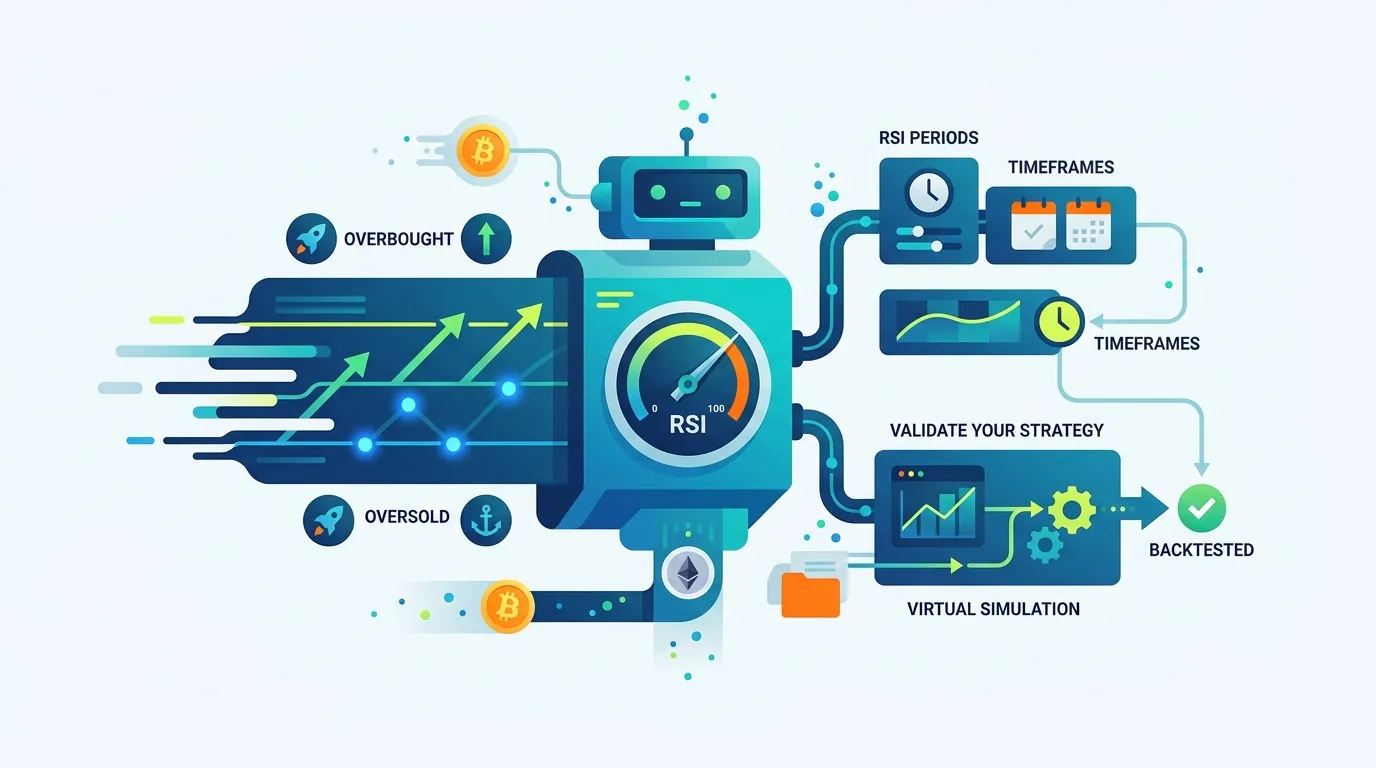
RSI Crypto Trading Bot: A Practical Build Guide
Learn how an RSI crypto trading bot detects overbought and oversold conditions, how to configure RSI periods and timeframes, and how to validate your strategy before going live.

How to Build a Crypto Stop-Loss Trailing Stop Bot That Protects Every Position
Learn how to build a crypto stop-loss trailing stop bot that automatically monitors multiple trading pairs, locks in gains, and limits downside without manual intervention.

DCA Crypto Trading Bot: How It Works and How to Build One
Learn how a DCA crypto trading bot automates dollar-cost averaging, how to configure intervals, order sizes, and safety orders, and how to build a custom DCA bot without writing code.