RSI Crypto Trading Bot: A Practical Build Guide
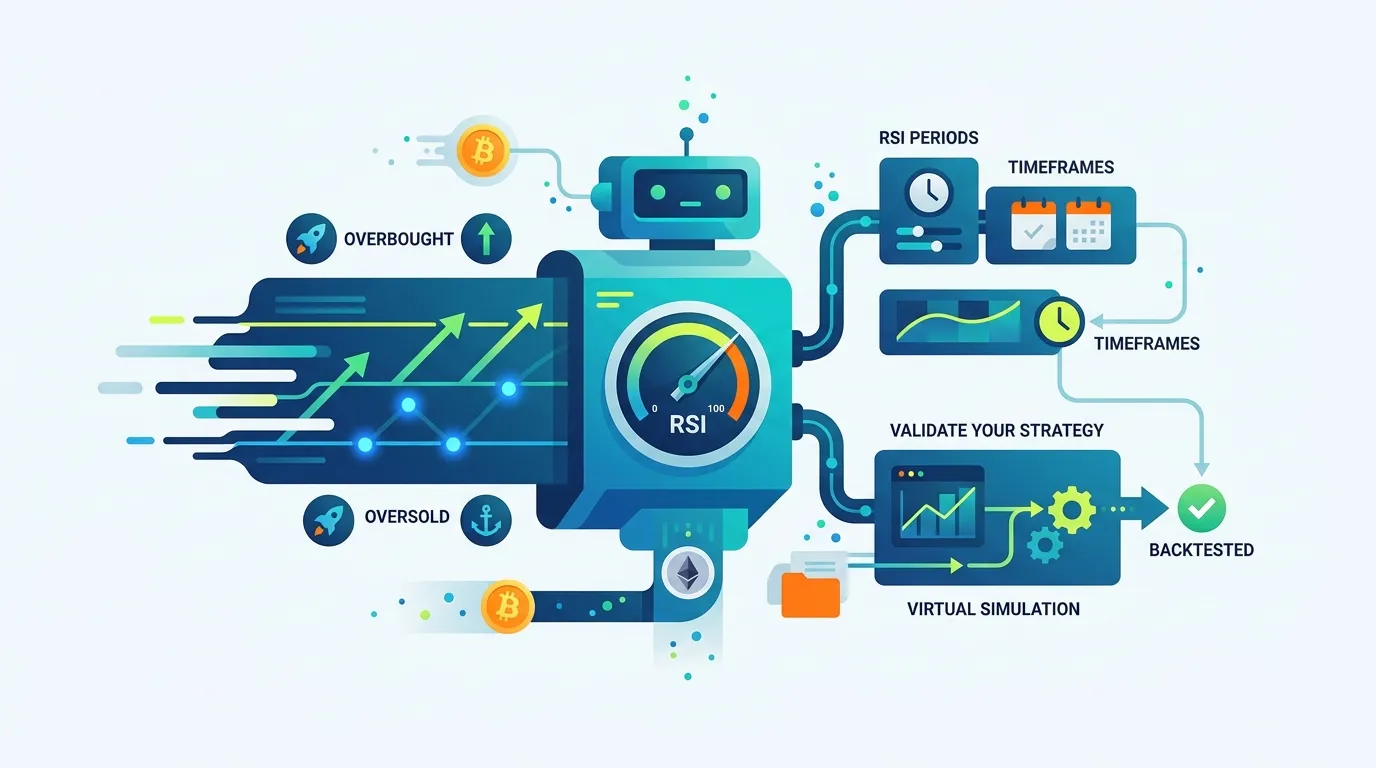
Spotting when a crypto asset is stretched too far in one direction — and acting on it before emotion takes over — is the core promise of momentum-based automation. An RSI crypto trading bot operationalizes exactly that: it reads the Relative Strength Index in real time, compares it to your chosen thresholds, and fires buy or sell orders without hesitation or second-guessing. This guide walks through every layer of that system, from indicator math to live deployment.
How Does an RSI Crypto Trading Bot Work?
An RSI crypto trading bot continuously polls OHLCV (open, high, low, close, volume) candle data from a connected exchange, recalculates the RSI on each new candle, and evaluates two conditions: if RSI drops below 30, the asset is considered oversold and a buy signal is generated; if RSI rises above 70, the asset is considered overbought and a sell signal fires. Because the bot applies these rules identically on every candle, it removes the emotional bias that causes human traders to hesitate at critical moments.
What Is RSI and Why Do the 30/70 Levels Matter?
The Relative Strength Index is a momentum oscillator developed by J. Welles Wilder Jr. in 1978. It measures the ratio of average gains to average losses over a lookback period and compresses the result into a 0–100 scale.
The standard formula:
RS  = Average Gain over N periods / Average Loss over N periods
RSI = 100 − (100 / (1 + RS))
A reading below 30 signals that sellers have dominated recent price action to a degree that may be unsustainable — a potential mean-reversion opportunity. A reading above 70 signals the opposite. These are not guaranteed reversal points; they are probabilistic thresholds that, when confirmed by other conditions, give a bot a structured entry and exit framework.
"RSI doesn't tell you where price is going — it tells you how fast it got there. Automation turns that speed measurement into a repeatable decision rule."
For automated systems, discrete thresholds matter enormously: a bot can act on "RSI < 30" but cannot act on "this feels oversold." That precision is what makes RSI one of the most popular indicators in algorithmic crypto trading.
What Is the Best RSI Setting for Crypto Trading Bots?
There is no universally "best" setting, but the choices below cover the most common use cases:
| RSI Period | Typical Timeframe | Trading Style | Signal Frequency |
|---|---|---|---|
| 7 | 15m / 1h | Scalping | High (noisier) |
| 14 | 1h / 4h | Swing trading | Moderate |
| 21 | 4h / Daily | Position trading | Low (cleaner) |
Period 14 on the 4-hour chart is a solid baseline for most crypto bots. It balances signal frequency against noise, and it was Wilder's own recommendation. If you are trading highly volatile assets like smaller-cap altcoins, lengthening the period to 21 can reduce whipsaws. For high-frequency setups on liquid pairs like BTC/USDT, period 7 on the 1-hour chart can surface more opportunities — at the cost of more false positives.
The threshold levels themselves can also be tuned: some bot operators shift them to 25/75 in strongly trending markets to avoid fighting momentum, or tighten them to 35/65 in ranging markets to capture smaller oscillations.
Combining RSI With Secondary Filters to Reduce False Signals
A single RSI threshold crossing is frequently a false signal, especially in trending markets where RSI can stay above 70 for extended periods. Adding a secondary filter dramatically improves signal quality:
1. Volume Confirmation
Only act on an RSI oversold signal if 24-hour volume on that candle is at least 20% above its 20-period average. A volume spike alongside a low RSI reading suggests real capitulation, not just thin-order-book drift.
2. Moving Average Trend Filter
Apply a 200-period EMA. Only take long signals (RSI < 30) when price is above the 200 EMA — trading in the direction of the longer-term trend. Ignore buy signals when price is below it.
3. RSI Divergence Detection
When price makes a lower low but RSI makes a higher low, that bullish divergence is a stronger mean-reversion signal than an absolute threshold cross alone. This logic is more complex to code but meaningfully reduces false entries.
"A filter doesn't eliminate losing trades — it shifts your signal distribution toward higher-probability setups, which is all systematic trading can honestly promise."
Risk Controls Every RSI Bot Needs
Signal quality means nothing without position-level risk management. Before wiring up your exchange API, define these parameters:
- Stop-loss distance — A fixed percentage (e.g., 2–3% below entry) or an ATR-based dynamic stop prevents a single trade from becoming a catastrophic loss.
- Position sizing — Risk a fixed fraction of your portfolio per trade (commonly 1–2%) rather than a fixed number of coins. This keeps individual losses bounded regardless of asset price.
- Maximum open positions — Cap the number of concurrent RSI signals the bot can act on to control total portfolio exposure.
- Cooldown period — After a stop-loss triggers, pause new entries on that pair for N candles to avoid re-entering a continuing downtrend.
These controls work together: even if your RSI thresholds generate several losing signals in a row, the combination of small position sizing and hard stops keeps drawdowns manageable.
How to Backtest Your RSI Bot Before Going Live
Backtesting runs your bot's logic against historical candle data to measure how it would have performed. It won't predict the future, but it can reveal obvious parameter flaws before real capital is at risk.
A minimal Python backtest loop using the pandas library and the ta library for RSI looks like this:
import pandas as pd
import ta

# df is a DataFrame with columns: open, high, low, close, volume
df["rsi"] = ta.momentum.RSIIndicator(df["close"], window=14).rsi()

df["signal"] = 0
df.loc[df["rsi"] < 30, "signal"] = 1   # buy
df.loc[df["rsi"] > 70, "signal"] = -1  # sell

# Vectorised P&L (simplified, no compounding or fees)
df["returns"] = df["close"].pct_change()
df["strategy"] = df["signal"].shift(1) * df["returns"]
cumulative = (1 + df["strategy"]).cumprod()
print(f"Final equity multiplier: {cumulative.iloc[-1]:.3f}")
Key things to measure from your backtest: win rate, average win vs. average loss ratio, maximum drawdown, and number of trades. If a parameter set produces a high win rate but huge drawdown, it is not a viable live configuration.
Always backtest across at least two full market cycles (bull + bear) for crypto, since RSI behaves very differently in trending versus ranging conditions.
Can You Automate RSI Trading Strategies in Crypto?
Yes — and several paths exist depending on your technical depth:
- Python + CCXT library: Write your own polling loop, indicator calculation, and order-placement logic. Maximum flexibility, maximum maintenance burden.
- TradingView Pine Script alerts → webhook → bot: Define RSI signals in Pine Script and route alerts to a bot server via webhooks. Lower coding overhead, but adds latency.
- AI-powered bot builders: Describe your RSI strategy in plain language and have the code generated and deployed automatically.
Each path eventually requires connecting to an exchange via API keys, handling rate limits, managing order state, and dealing with edge cases like partial fills and network outages — complexity that grows quickly once you move beyond a toy implementation.
Which Crypto Exchanges Support RSI Trading Bots?
Any exchange that exposes a REST or WebSocket API supports RSI bots, because the bot fetches candle data and submits orders programmatically. Major exchanges with well-documented APIs include Binance, Coinbase Advanced Trade, Kraken, Bybit, and OKX. When evaluating exchange support, check for:
- OHLCV historical data endpoints (needed for backtest and live RSI calculation)
- Order types: limit, market, and ideally conditional/stop orders
- API rate limits (critical for short-timeframe bots polling every minute)
- Testnet / paper-trading environment for validating bot behavior without real funds
How Do I Build an RSI Crypto Trading Bot in Python?
Building a minimal live RSI bot in Python involves five components:
- Data feed — Use
ccxtto pull candle data:exchange.fetch_ohlcv('BTC/USDT', '4h', limit=100) - Indicator calculation — Compute RSI with
ta.momentum.RSIIndicator(closes, window=14).rsi() - Signal logic — Evaluate the latest RSI value against your thresholds
- Order placement — Call
exchange.create_order(symbol, 'market', 'buy', amount)when signal fires - Scheduling loop — Run the full pipeline on a
while Trueloop withtime.sleep()aligned to your candle close
Add position state tracking (are we in a trade or not?), stop-loss monitoring, and error handling for network failures. A production-quality bot will also log every signal and order to a persistent store for post-trade analysis.
What Are the Pros and Cons of Using an RSI Bot for Crypto Trading?
Pros:
- Removes emotional decision-making from entries and exits
- Operates 24/7 across multiple pairs simultaneously
- Rules are explicit and testable via backtesting
- Can react to RSI signals faster than any human
Cons:
- RSI produces frequent false signals in strong trending markets
- Backtested results do not guarantee future performance
- Requires exchange API access and ongoing infrastructure maintenance
- Parameter choices (period, thresholds) still require human judgment and regular review
Wrapping Up
An RSI crypto trading bot converts a well-understood momentum indicator into a disciplined, always-on decision engine. The foundation is straightforward — poll candles, calculate RSI, act on threshold crossings — but the edge comes from thoughtful configuration: the right period and timeframe for your market, secondary filters to reduce noise, and hard risk controls that keep losses bounded. Backtest rigorously, and treat live deployment as the beginning of an ongoing tuning process, not a finish line.
If you want to skip the infrastructure setup, Cryptohopper.AI lets you describe your RSI bot logic in plain language; it generates the code and deploys it automatically on a hosted environment connected to your Cryptohopper account — no server management required.
Crypto trading involves substantial risk of loss. Nothing in this article constitutes financial or investment advice.
Frequently asked questions
How does an RSI crypto trading bot work?
An RSI crypto trading bot fetches OHLCV candle data from a connected exchange, calculates the Relative Strength Index on each new candle, and fires a buy order when RSI drops below 30 (oversold) or a sell order when RSI rises above 70 (overbought). The process repeats automatically on every candle close, removing emotional bias from the decision.
What is the best RSI setting for crypto trading bots?
There is no single best setting, but RSI period 14 on the 4-hour chart is the most common starting point — it balances signal frequency against noise. Scalping bots often use period 7 on the 1-hour chart for more signals; swing or position-trading bots may use period 21 on the daily chart for cleaner, lower-frequency signals.
Can you automate RSI trading strategies in crypto?
Yes. You can automate RSI strategies by writing a Python bot using the CCXT library to fetch candle data and place orders, by routing TradingView Pine Script alerts via webhooks, or by using an AI-powered bot builder that generates and deploys the code for you. All approaches require connecting to an exchange API.
What are the pros and cons of using an RSI bot for crypto trading?
Pros: removes emotional bias, runs 24/7 across multiple pairs, rules are explicit and testable via backtesting. Cons: RSI generates frequent false signals in trending markets, backtested results do not guarantee future performance, and the bot requires API access, ongoing maintenance, and regular parameter review.
How do I build an RSI crypto trading bot in Python?
Use the CCXT library to fetch candle data, the 'ta' library to calculate RSI, and a simple while-True loop to run the pipeline on each candle close. Add signal logic (RSI < 30 = buy, RSI > 70 = sell), order placement via ccxt's create_order method, and position-state tracking with a stop-loss check. Always test on a paper-trading account before using real funds.
Which crypto exchanges support RSI trading bots?
Any exchange with a REST or WebSocket API supports RSI bots. Well-documented options include Binance, Coinbase Advanced Trade, Kraken, Bybit, and OKX. Look for OHLCV historical data endpoints, support for limit and stop orders, reasonable API rate limits, and a testnet or paper-trading environment for safe bot validation.
Subscribe to the Cryptohopper newsletter
New posts, product updates, and the occasional lesson — straight to your inbox.
We'll never share your email. Unsubscribe anytime.
Related articles

Backtesting a Crypto Trading Bot Strategy: A Practical Guide
Learn how to backtest a crypto trading bot strategy on historical candle data, interpret key metrics, avoid common pitfalls, and decide when your strategy is ready to go live.

MACD Crossover Crypto Trading Bot: A Complete Builder's Guide
Learn how to build a MACD crossover crypto trading bot that reads histogram momentum shifts to automate entries and exits — from signal logic to parameter tuning and backtesting.

Crypto Trading Bot Backtesting: A Complete Practical Guide
Learn how to backtest a crypto trading bot on historical candle data, interpret key metrics like Sharpe ratio and max drawdown, avoid common pitfalls, and refine your strategy before going live.