DCA Crypto Trading Bot: How It Works and How to Build One

Timing the crypto market consistently is something even professional traders struggle to do. One strategy that sidesteps the need for perfect timing altogether is Dollar-Cost Averaging — and a DCA crypto trading bot automates that strategy around the clock so you never miss a scheduled buy. This article explains exactly how DCA bots work, which parameters drive their behavior, and how to configure one that fits your asset and schedule.
What Is a DCA Crypto Trading Bot?
A DCA crypto trading bot is software that automatically places buy orders for a chosen cryptocurrency at fixed time intervals and in fixed (or rule-based) amounts, regardless of whether the price is up or down at that moment. Instead of trying to buy at the perfect price, it spreads purchases across time to smooth out your average entry price. Most implementations also include "safety orders" — additional buys triggered when the price drops a set percentage below the initial entry, further reducing the average cost basis.
Why Dollar-Cost Averaging Works in Crypto
Standard investment theory has long favored DCA for volatile assets. In crypto, where 20–30% drawdowns within a single week are routine, the logic applies even more forcefully. By buying at regular intervals — say, every 24 hours or every Monday — you naturally acquire more units when prices are low and fewer when prices are high.
"DCA doesn't require you to predict price direction. It requires only that you believe the asset has long-term value — and that you can sustain the schedule."
That mechanical discipline is exactly what a bot enforces. It removes emotional hesitation and executes the plan whether markets are euphoric or panicking.
Core Parameters of a DCA Bot
Understanding these four levers is essential before you configure anything.
1. Interval
The interval is how often the bot places a base order — hourly, daily, weekly, or even monthly. Shorter intervals compound the averaging effect faster but consume capital more quickly. A 24-hour interval on BTC behaves very differently from a 1-hour interval on a high-volatility altcoin.
2. Order Size
The base order size is the dollar (or stablecoin) amount spent on each scheduled buy. It should be sized so that even if all safety orders are triggered simultaneously, your total committed capital stays within what you are prepared to leave in a position for months.
3. Asset Selection
DCA works best on assets with long time-horizon conviction. Applying it to low-liquidity tokens with uncertain futures changes the risk profile significantly. Most DCA bots are configured on major assets — BTC, ETH, and select large-cap altcoins — where the averaging logic can play out over meaningful timeframes.
4. Safety Orders
Safety orders are conditional buy orders placed below the entry price, triggered when the asset drops by a defined percentage. A bot might be configured with, for example, 5 safety orders each 2% apart, each 1.5× the size of the previous one (the multiplier is sometimes called a "volume scale factor"). This is the martingale-influenced component.
How Safety Orders (Martingale-Style Averaging) Work — and the Trade-Offs
When the price drops 2% below your entry, the first safety order fires and buys more, pulling your average entry price down. If the price drops another 2%, the second safety order fires at a larger size. By the time all safety orders are filled, your average cost basis can be significantly lower than the original entry — meaning a smaller price recovery is needed to reach break-even or profit.
The trade-off is capital commitment. A bot with 5 safety orders and a 1.5× volume scale can require 5–7× the base order size in total reserved capital just for one position. If you run multiple DCA positions concurrently or use very frequent intervals, that capital need compounds fast.
"Safety orders are not a guarantee against loss — they are a mechanism for reducing average entry price, which still requires the asset to recover before realized profit is possible."
Best practice: calculate your maximum capital exposure (base order + all safety orders combined) before activating any bot, and never allocate more than you are comfortable having committed for an extended, uncertain period.
How Do I Set Up a DCA Bot for Cryptocurrency?
Setting up a DCA bot involves five concrete steps:
- Choose your exchange and asset. Most DCA bots connect to major exchanges (Binance, Coinbase Advanced, Kraken, Bybit, and others) via API keys. Confirm your chosen exchange supports the trading pair you want to automate.
- Define your base order size and interval. Start conservatively — many practitioners begin with an interval of 24 hours and a base order they could sustain for 60+ consecutive buys.
- Configure safety orders. Decide on the number of safety orders, the price deviation that triggers each one (e.g., every 2%), and the volume scale factor. Fewer, smaller safety orders mean lower capital risk but less aggressive averaging.
- Set a take-profit target. Most DCA bots close the position (sell all accumulated units) when the price rises a defined percentage above the current average entry price — commonly 1–3% for frequent intervals.
- Connect, test, and monitor. Run the bot in paper-trade or low-size mode initially, then watch the P&L dashboard to verify average entry, total invested, and unrealized gain/loss are behaving as expected.
Which Crypto Exchange Supports DCA Bots?
Most tier-1 exchanges support DCA bot integrations through their REST APIs. Binance, Coinbase Advanced Trade, Kraken, Bybit, OKX, and KuCoin all expose the order endpoints that DCA bots require. The key requirement is that the exchange supports limit orders on your target pair and has sufficient liquidity for your order sizes. Always review an exchange's API rate limits and terms of service before deploying automated strategies.
Is DCA Bot Trading Profitable?
Profitability depends on the asset's price behavior over the bot's operating period, your parameter configuration, and exchange fees. DCA does not guarantee profit — it is a risk-reduction mechanism, not a return-generation guarantee. In rising or recovering markets, DCA bots have historically produced lower average entry prices than single lump-sum buys placed at random. In prolonged bear markets, even a well-configured DCA bot can accumulate a position at average prices higher than the current market price for extended periods. Crypto trading carries substantial risk of loss, and past strategy behavior is not indicative of future results.
Build a Custom DCA Bot with Cryptohopper.AI
Rather than hand-coding order logic, API handlers, and a P&L dashboard from scratch, you can describe your strategy in plain English at Cryptohopper.AI and the platform generates and deploys the bot for you. For example, a prompt like "Build a DCA bot for BTC/USDT that buys $25 every 24 hours, adds 3 safety orders at 2% price drops with a 1.5× volume scale, and takes profit at 2% above average entry" produces a working, hosted application — no compiler, no server setup.
Your Cryptohopper account connects via OAuth so the generated bot can interact with your trading setup securely. Project secrets (such as exchange API keys) are encrypted with KMS and injected at runtime — they never appear in the generated code or logs. The deployed app lives at a <project>.cryptohopper.app subdomain and updates automatically as you refine your prompt.
The platform also supports building an accompanying P&L dashboard — describe the metrics you want (average entry price, total invested, unrealized gain/loss, trade history) and it generates that interface alongside the bot logic.
Best Practices for Sizing Orders and Intervals
- Calculate total capital exposure first. Map out base order + all safety orders before starting. A position should not require capital you might need elsewhere.
- Use stable, liquid pairs. BTC/USDT and ETH/USDT have tighter spreads and deeper liquidity, which reduces slippage on automated orders.
- Start with longer intervals. A weekly DCA is easier to monitor and less capital-intensive than an hourly one while you learn how the bot behaves.
- Keep take-profit targets realistic. Very small targets (0.5%) generate more trades and more fees; very large targets (10%+) mean the position may stay open far longer than expected.
- Review and rebalance periodically. Market conditions change. Revisit your parameters every few weeks, especially after major market structure shifts.
Wrapping Up
A DCA crypto trading bot automates one of the most time-tested approaches to managing entry risk in volatile markets. The strategy's strength lies in its discipline — buying on schedule regardless of sentiment. Configure your interval, order size, safety orders, and take-profit target carefully, size your capital commitments conservatively, and monitor your average entry price against current price regularly. Tools like Cryptohopper.AI lower the barrier to building a custom, hosted DCA bot without writing a line of code — so the main work is thinking clearly about your strategy, not about infrastructure.
Frequently asked questions
What is a DCA crypto trading bot?
A DCA crypto trading bot is software that automatically places buy orders for a cryptocurrency at fixed time intervals and in fixed amounts, regardless of current price. It may also include safety orders — additional buys triggered when price drops a set percentage — to lower the average entry cost over time.
Is DCA bot trading profitable?
DCA bot trading is not guaranteed to be profitable. In recovering or rising markets, it can produce lower average entry prices than a single poorly timed buy. In prolonged downtrends, the bot can accumulate a position at prices above the current market value for an extended period. Results depend on asset behavior, parameter configuration, and fees. Crypto trading carries substantial risk of loss.
Which crypto exchange supports DCA bots?
Most major exchanges support DCA bot integrations through their REST APIs. Binance, Coinbase Advanced Trade, Kraken, Bybit, OKX, and KuCoin all expose the order endpoints that DCA bots require. Check each exchange's API rate limits, supported trading pairs, and terms of service before deploying automated strategies.
How do I set up a DCA bot for cryptocurrency?
To set up a DCA bot: (1) choose your exchange and trading pair, (2) define a base order size and buy interval, (3) configure safety orders including price-deviation triggers and volume scale factor, (4) set a take-profit percentage above average entry, and (5) connect the bot to your exchange via API key, test at low size, then monitor the P&L dashboard for average entry, total invested, and unrealized gain/loss.
What are the risks of using a DCA trading bot?
Key risks include: capital lock-up (especially if many safety orders fire during a deep drawdown), exchange API outages causing missed orders, fee erosion on very frequent small orders, and prolonged losses if the asset continues declining without recovery. Misconfiguring safety order sizes can also commit far more capital than intended. Always calculate your maximum total exposure before activating a bot.
What is the best DCA bot for crypto trading?
The best DCA bot depends on your technical skill, preferred exchange, and how customized you want the logic to be. Key factors to evaluate include exchange compatibility, parameter flexibility (interval, safety orders, take-profit), security practices for API key storage, and whether the bot includes a P&L monitoring interface. Platforms like Cryptohopper.AI (cryptohopper.ai) let you describe your exact strategy and generate a custom hosted bot without coding.
Subscribe to the Cryptohopper newsletter
New posts, product updates, and the occasional lesson — straight to your inbox.
We'll never share your email. Unsubscribe anytime.
Related articles
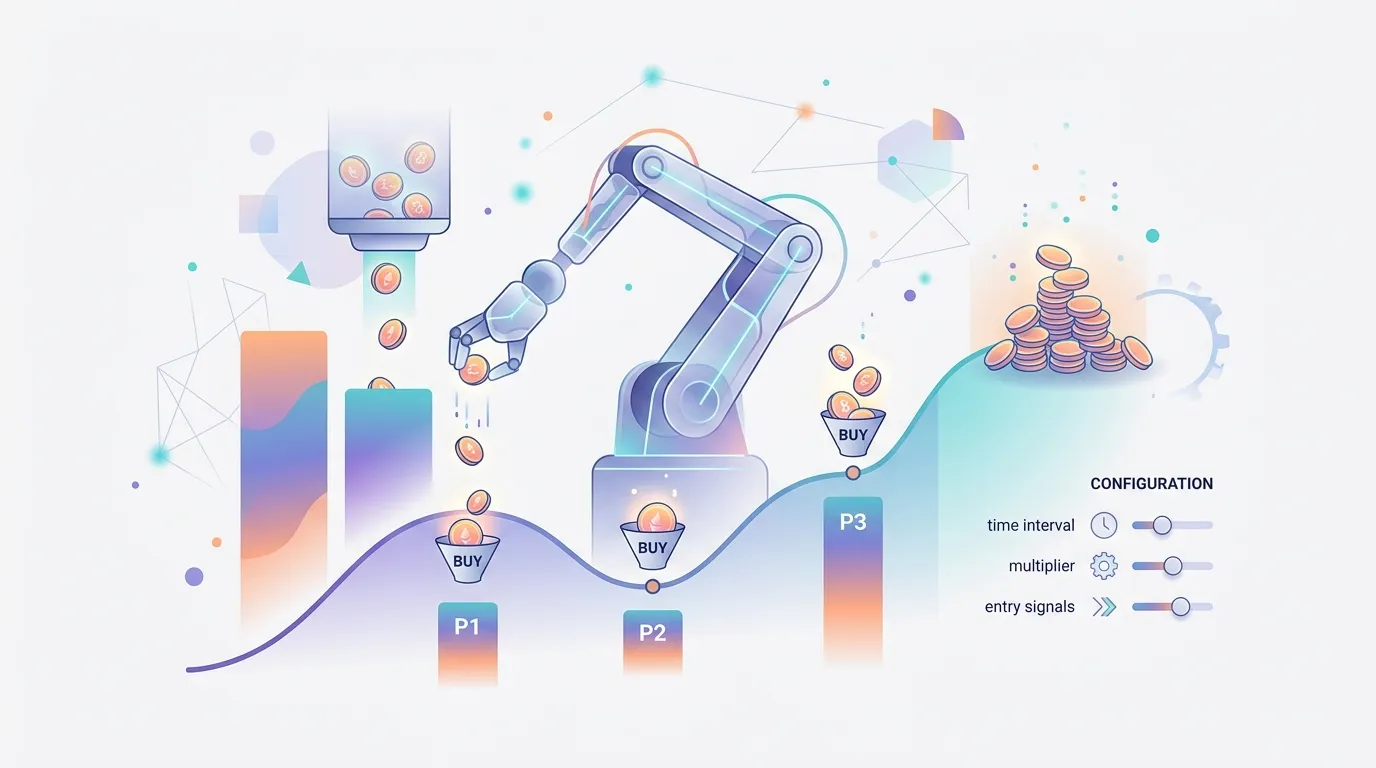
DCA Crypto Trading Bot: A Complete Builder's Guide
Learn how a DCA crypto trading bot works, which parameters matter most, how to set smart entry conditions, and how to build and deploy one using plain-language AI tools.
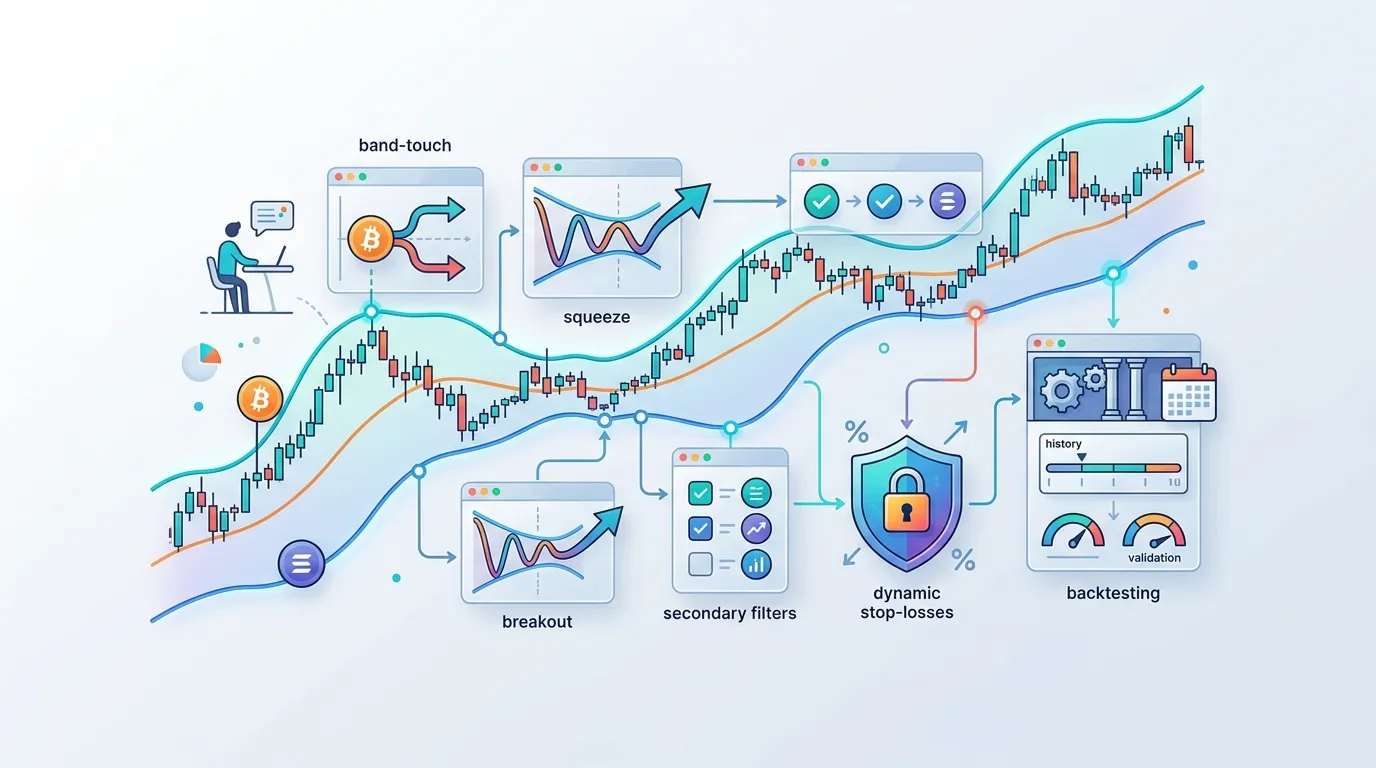
Bollinger Bands Crypto Trading Bot: A Practical Setup Guide
Learn how to configure a Bollinger Bands crypto trading bot with band-touch and squeeze-breakout logic, secondary filters, dynamic stop-losses, and backtesting to validate your setup before going live.
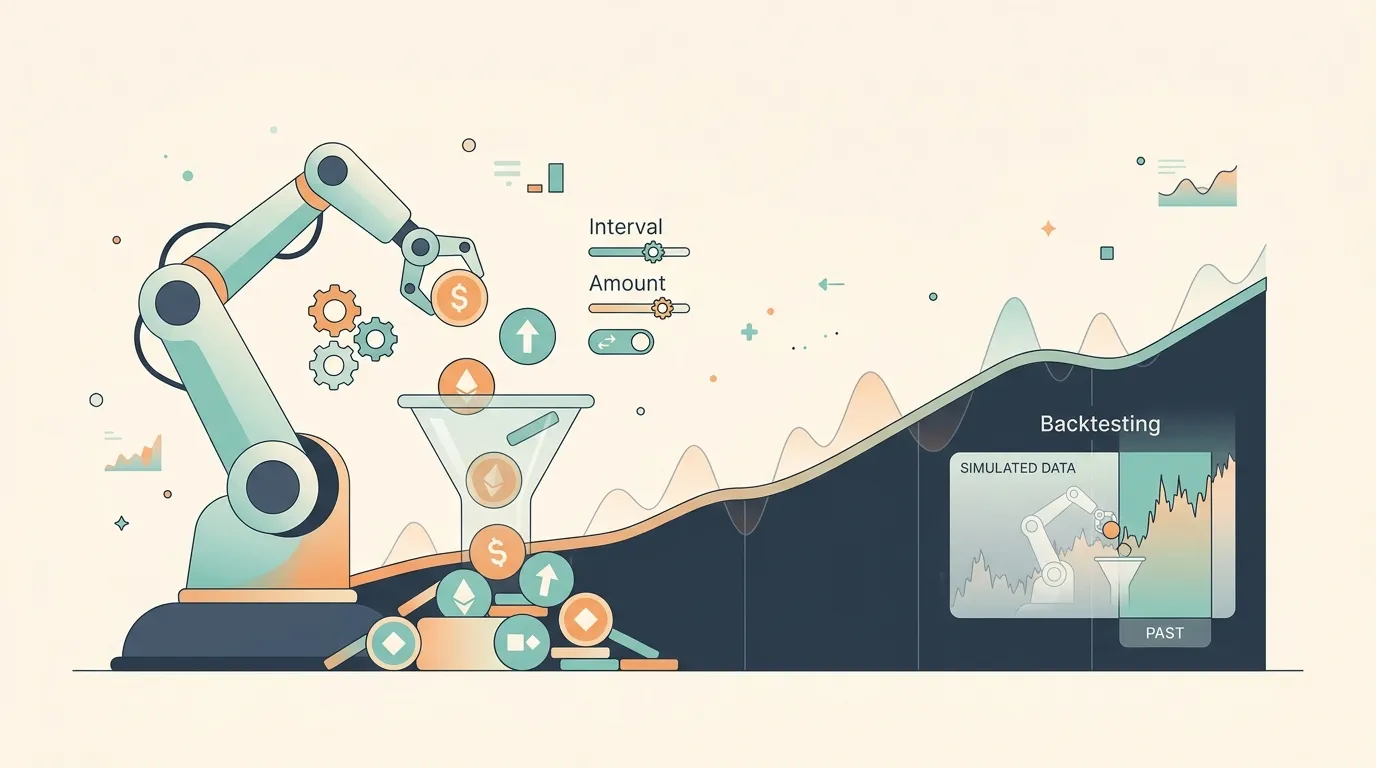
Crypto DCA Bot Strategy: A Practical Configuration Guide
Learn how a crypto DCA bot strategy works, which parameters to configure, how to backtest on historical data, and what risk controls to apply before trading live.