How to Build a DCA Crypto Trading Bot: A Practical Guide
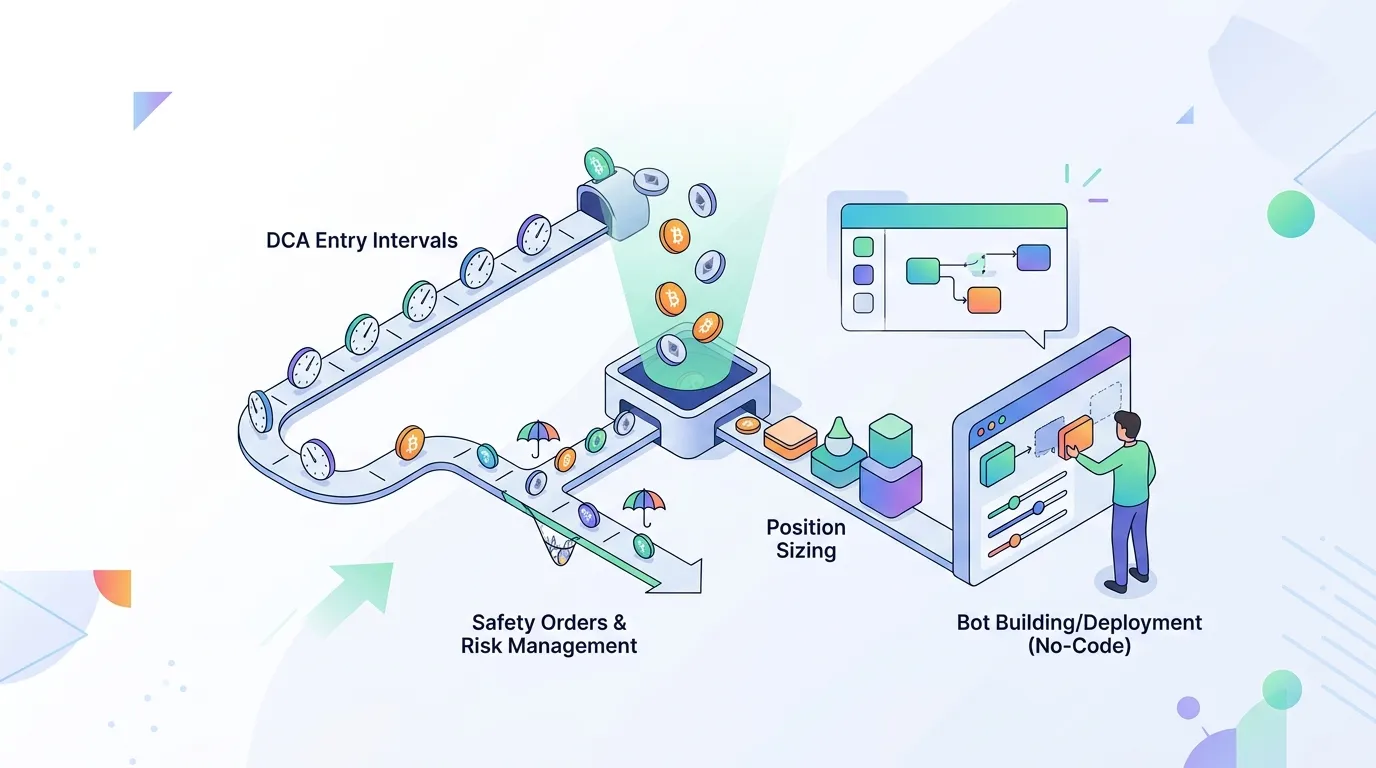
Timing the crypto market is notoriously difficult — even experienced traders get it wrong. Dollar-Cost Averaging sidesteps that problem by spreading purchases across time rather than betting everything on a single entry point. A DCA crypto trading bot automates that logic around the clock, removing emotion and execution lag from the equation. This guide explains how the strategy works, which parameters matter most, and how to go from a plain-language description to a running bot.
What Is a DCA Crypto Trading Bot?
A DCA crypto trading bot is an automated program that purchases a cryptocurrency at regular intervals or at predefined price-drop thresholds, regardless of current market conditions. Instead of one large buy, it splits your capital into multiple smaller orders — a base order followed by "safety orders" placed at progressively lower prices — to reduce average entry cost during downturns. Most implementations also include a configurable take-profit target to close the position once a target return is reached.
Dollar-Cost Averaging doesn't eliminate risk, but it transforms timing risk into sequence risk — a trade many traders prefer when dealing with volatile assets like crypto.
Is Dollar-Cost Averaging a Good Strategy for Crypto?
DCA is widely regarded as one of the most accessible strategies for crypto trading because it removes the psychological pressure of picking a perfect entry. By spreading purchases across time or price levels, you avoid the all-in risk of buying right before a sharp correction. However, DCA is not a guaranteed profit mechanism. In a prolonged bear market, averaging down can increase total exposure to a falling asset. It works best when applied to assets you believe have long-term relevance and when strict capital limits are enforced per trade. Trading crypto carries substantial risk of loss — no strategy changes that fundamental reality.
Key Parameters Every DCA Bot Needs
Understanding these five levers is the foundation of any DCA configuration:
-
Base Order Size — The amount of capital placed on the very first buy. This is your initial entry into a position. Keep it modest relative to your total allocated capital so safety orders have room to fire.
-
Safety Order Size — The size of each follow-up buy triggered when the price drops by the configured deviation. Safety orders can be set to a flat amount or scaled multiplicatively (e.g., each order is 1.5× the previous one).
-
Price Deviation Trigger — The percentage price drop required to activate each safety order. A 2% deviation means the bot places a new buy every time the price falls another 2% from the last order.
-
Maximum Safety Orders — How many follow-up buys the bot is allowed to place in a single deal. More safety orders means more averaging capacity but also more capital required and greater total exposure.
-
Take-Profit Target — The percentage gain (measured from the volume-weighted average entry price) at which the bot closes the position and books the return.
A simple example: a base order of $50 on BTC/USDT, three safety orders of $100 each at 2% deviation intervals, and a 1.5% take-profit. If BTC drops 6% after entry, all safety orders are filled and the average cost is meaningfully lower than the original entry price.
How Do I Set Up a DCA Bot on Binance or Coinbase?
Setting up a DCA bot on a supported exchange — including Binance and Coinbase Advanced — typically involves five steps:
- Define your strategy in plain language. Describe what you want: "Buy ETH/USDT with a $40 base order, place up to four safety orders of $80 each every 2.5% price drop, take profit at 1.8%, stop-loss at 12%."
- Connect your exchange account. The bot needs read and trade permissions via API key (Binance) or OAuth (Coinbase). It reads live price data and places orders on your behalf through your own account — the platform never holds your funds.
- Configure risk limits. Set a maximum number of simultaneous open deals to cap total capital at risk at any moment.
- Backtest against historical data. Run the configuration against past candle data for the trading pair to observe how it would have behaved across different market conditions.
- Go live with a small allocation. Start with paper trading or a small real position to validate live execution before scaling up.
No DCA bot can predict the future. Backtesting shows historical behavior, not future results — always size positions you can afford to lose entirely.
How to Build a DCA Bot with Cryptohopper.AI
Cryptohopper.AI is an AI-powered builder that lets you describe a trading tool in plain English and generates, deploys, and hosts it automatically — no manual coding or deployment steps required.
Describing Your Bot
Instead of writing code, you type a prompt like: "Build a DCA bot for BTC/USDT. Base order $50, three safety orders of $100 at 2% deviation steps with a 1.5× multiplier, take profit at 2%, stop-loss at 15%. Show a live P&L dashboard." The platform interprets your intent, generates the bot logic, and deploys it to a free yourproject.cryptohopper.app subdomain automatically.
Connecting Your Cryptohopper Account
You link your existing Cryptohopper account via OAuth. This gives your generated bot secure access to your Cryptohopper configuration and exchange connections. Your API keys and secrets are encrypted at rest with KMS and injected at runtime — they never appear in generated code or logs. An active Cryptohopper subscription is needed to build and iterate; every plan includes monthly AI Credits.
Refining Iteratively
Because deployment is continuous and automatic, you can iterate: "Add a maximum of five open deals at once" or "Switch safety order sizing to a 2× multiplier" — and the updated bot is live within seconds, no manual redeploy needed.
Backtesting Your DCA Strategy Before Going Live
Backtesting runs your DCA configuration against historical OHLCV (open/high/low/close/volume) candle data to estimate how it would have performed. A useful backtest should cover:
- Multiple market regimes: at least one strong uptrend, one sideways range, and one sharp drawdown period.
- Pair-specific volatility: a 2% deviation trigger behaves very differently on BTC/USDT (relatively stable) versus a small-cap altcoin (high volatility).
- Capital exhaustion scenarios: check whether your safety orders would have been fully consumed in the worst drawdowns you tested.
Backtest results are informative, not predictive. A configuration that looked excellent on 2021 data might behave entirely differently in a different volatility regime.
What Are the Risks of Using a DCA Bot for Cryptocurrency?
No automation removes market risk. The main risks specific to DCA bots include:
- Capital exhaustion: If price keeps falling past your final safety order, the bot can no longer average down and holds a losing position with no further buys available.
- Over-exposure: Running too many simultaneous deals across multiple pairs multiplies total capital at risk. Always set a hard maximum on open deals.
- Exchange API downtime: Orders may fail if the exchange API is unavailable. Monitor your bot's activity regularly rather than assuming it's running correctly.
- Stop-loss slippage: In fast-moving markets, stop-loss orders may execute at a worse price than configured.
- Rug pulls and liquidity events: DCA bots have no knowledge of project fundamentals. Averaging into a collapsing asset compounds losses rather than reducing them.
Mitigate these risks by: setting conservative position sizes (never more than you can afford to lose on any single deal), using stop-losses on every deal, capping maximum open positions, and reviewing your P&L dashboard daily.
Are Crypto Trading Bots Safe to Use?
The safety of a crypto trading bot depends on three dimensions: platform security, strategy configuration, and market risk. A well-built bot on a reputable platform will use encrypted credential storage, never request withdrawal permissions from your exchange, and execute only within the parameters you define. Strategy configuration risk is entirely in your hands — an aggressive DCA setup with no stop-loss and unlimited safety orders is inherently risky regardless of the platform. Market risk is irreducible: bots operate in volatile markets and can generate losses. Treat bot automation as a tool that enforces discipline, not one that guarantees profits.
Wrapping Up
A DCA crypto trading bot automates one of the most time-tested ways to manage entry risk in volatile markets — but configuration quality and risk management determine whether it performs well or amplifies losses. Define your parameters carefully, stress-test with backtesting, set hard limits on open deals, and monitor P&L actively. If you want to build and deploy a custom DCA bot without writing a line of code, Cryptohopper.AI lets you describe exactly what you want in plain English and handles the rest automatically.
Frequently asked questions
What is a DCA crypto trading bot?
A DCA crypto trading bot is an automated program that buys a cryptocurrency in multiple smaller orders spread across time or price levels, rather than in a single lump sum. It typically places a base order at entry and then follow-up 'safety orders' each time the price drops by a set percentage, lowering the average cost basis. A take-profit target closes the position once a defined gain is reached.
Which DCA crypto bots are the best for beginners?
Beginners benefit most from platforms that combine clear parameter configuration with built-in backtesting and straightforward exchange connectivity. Look for tools that let you set a base order size, safety order count, deviation trigger, and take-profit without requiring programming knowledge. Platforms built on established trading infrastructure — like those connected to Cryptohopper — also provide a layer of security for exchange credentials.
Is dollar-cost averaging a good strategy for crypto?
DCA reduces the timing risk of entering a volatile market in a single large trade, making it one of the more accessible strategies for crypto. However, it is not risk-free: in a sustained downtrend, averaging down increases total exposure to a falling asset. It tends to work best on assets with long-term relevance when combined with strict position-size limits and stop-loss rules. Trading crypto always carries substantial risk of loss.
How do I set up a DCA bot on Binance or Coinbase?
Connect your exchange account to a DCA bot platform using an API key (Binance) or OAuth (Coinbase). Configure your base order size, safety order size and count, price deviation trigger, take-profit percentage, and stop-loss level. Backtest the configuration against historical data for your chosen pair before enabling live trading. Start with a small capital allocation to validate execution before scaling up.
What are the risks of using a DCA bot for cryptocurrency?
Key risks include capital exhaustion if price falls past all safety orders, over-exposure from running too many simultaneous deals, exchange API downtime causing missed orders, stop-loss slippage in fast markets, and the bot having no awareness of project fundamentals. Mitigate these by using conservative position sizes, mandatory stop-losses on every deal, a hard cap on maximum open deals, and regular monitoring of your P&L dashboard.
Subscribe to the Cryptohopper newsletter
New posts, product updates, and the occasional lesson — straight to your inbox.
We'll never share your email. Unsubscribe anytime.
Related articles
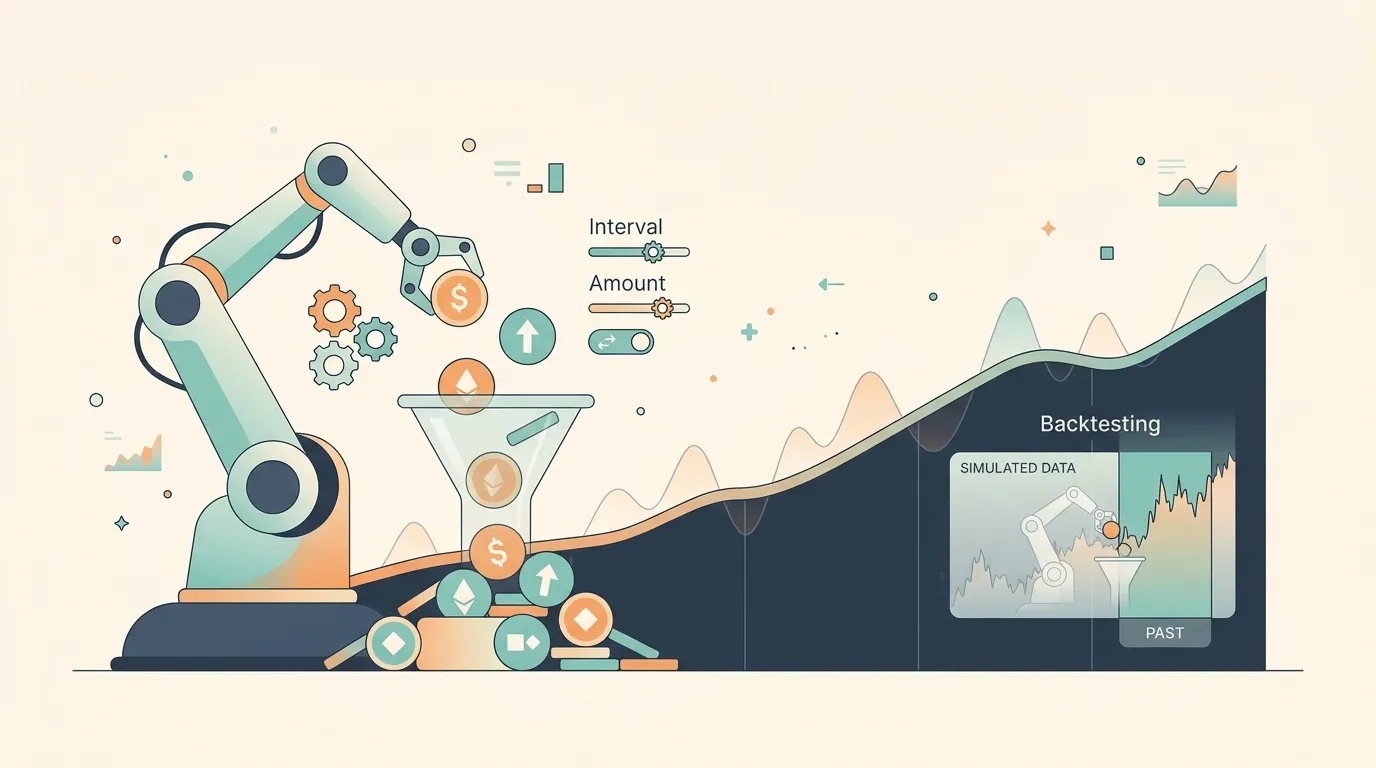
Crypto DCA Bot Strategy: A Practical Configuration Guide
Learn how a crypto DCA bot strategy works, which parameters to configure, how to backtest on historical data, and what risk controls to apply before trading live.
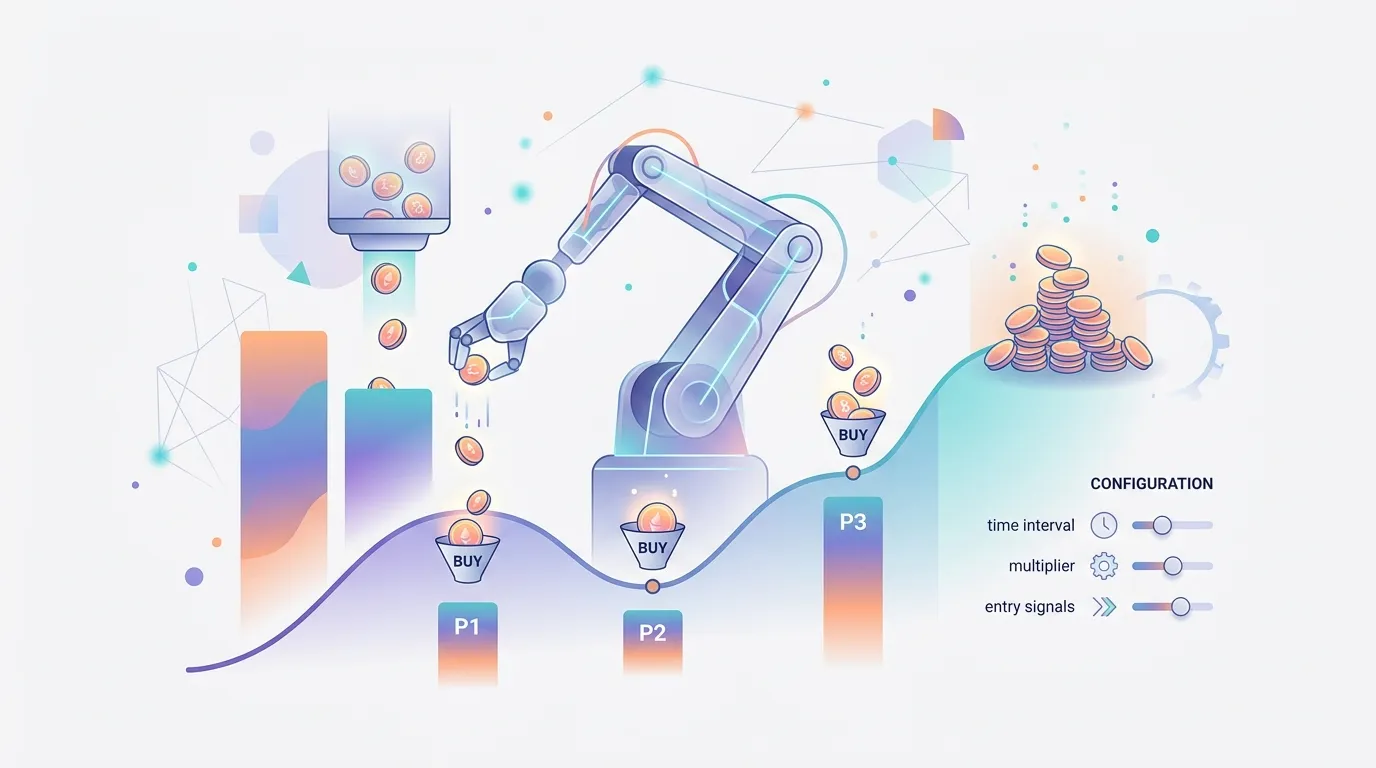
DCA Crypto Trading Bot: A Complete Builder's Guide
Learn how a DCA crypto trading bot works, which parameters matter most, how to set smart entry conditions, and how to build and deploy one using plain-language AI tools.

How to Build a Crypto Stop-Loss Trailing Stop Bot That Protects Every Position
Learn how to build a crypto stop-loss trailing stop bot that automatically monitors multiple trading pairs, locks in gains, and limits downside without manual intervention.