How to Build a Crypto Price Alert Bot That Monitors RSI and Bollinger Bands

Automated trading moves fast — sometimes too fast to catch a bad entry. A crypto price alert bot sits between raw market data and your trading decisions, giving you a structured, real-time heads-up the moment a technical threshold is crossed. This guide walks you through exactly how these bots work, what triggers to configure, and how to build one step by step.
How Do Crypto Price Alert Bots Work?
A crypto price alert bot continuously polls market data — prices, volume, and computed technical indicators — and compares current values against thresholds you define. When a condition is met (for example, RSI rising above 70 on a 1-hour BTC/USDT chart), the bot fires a notification through a configured delivery channel: a dashboard alert, a webhook to Telegram, Slack, or Discord, or a trigger for a downstream trading bot. The bot does not execute trades; it surfaces information at the right moment so that a human or an automated system can decide what to do next.
"The purpose of a price alert bot isn't to replace judgment — it's to make sure judgment is applied at the right moment, with the right data in front of you."
Why Pre-Signal Notifications Matter in Automated Trading
Execution speed is a double-edged sword in crypto. A bot that fires a market order the instant an RSI crosses 70 may catch the move — or it may chase a spike that reverses in seconds. Pre-signal alerts insert a deliberate pause: the alert fires first, and the trade only executes when a second confirmation condition is met (or when you manually approve it). This approach:
- Reduces false positives. A single indicator crossing a threshold is noisy. Requiring a human review or a second indicator confirmation filters out low-quality setups.
- Creates an audit trail. Every alert logged with a timestamp, asset, indicator value, and market context becomes a dataset you can use to improve your strategy over time.
- Builds trading intuition. Watching alerts fire — and then observing what the market actually does — is one of the fastest ways to understand how a strategy behaves across different conditions.
Key Trigger Types to Configure
1. Absolute Price Levels
The simplest trigger: fire an alert when an asset crosses a specific price. Example — alert when ETH/USDT breaks above $3,500 or falls below $2,800. Useful for key support/resistance levels, round numbers, and all-time highs.
2. RSI Threshold Crossings
The Relative Strength Index (RSI) oscillates between 0 and 100. The classic thresholds are:
- RSI > 70 → overbought territory (potential reversal or continuation depending on trend)
- RSI < 30 → oversold territory (potential bounce or continued sell-off)
Configure your bot to alert on the crossing — not just the state. An RSI that has been at 75 for six candles is less actionable than one that just crossed 70 for the first time.
3. Bollinger Band Touches and Breakouts
Bollinger Bands plot a moving average with upper and lower bands set at a defined number of standard deviations (typically 2). Alert triggers worth monitoring:
- Price closes above the upper band → breakout or mean-reversion signal depending on context
- Price closes below the lower band → potential oversold bounce
- Band squeeze (bands converging) → volatility contraction before an expansion move
4. MACD State Changes
The MACD histogram crossing from negative to positive (bullish crossover) or positive to negative (bearish crossover) is a widely watched momentum signal. Trigger alerts on the crossover candle to get notified at the earliest actionable moment.
How Do I Set Up a Crypto Price Alert Bot?
Setting up a crypto price alert bot involves five concrete steps:
- Choose your assets and timeframes. Decide which trading pairs to monitor (e.g., BTC/USDT, ETH/USDT, SOL/USDT on a 1H or 4H candle) and which exchange's data feed to use.
- Define your indicator thresholds. Pick the RSI levels, Bollinger Band parameters (period, standard deviations), and MACD settings appropriate for your strategy.
- Build the alert logic. Write (or generate) the code that computes indicators on each new candle and evaluates trigger conditions.
- Configure delivery channels. Decide whether alerts go to an on-screen dashboard, a webhook endpoint (Telegram bot token, Slack incoming webhook, Discord webhook URL), or both.
- Log and review alerts. Persist each fired alert — asset, timestamp, indicator value, price — so you can evaluate signal quality over time.
"Logging is not optional. Without a history of fired alerts, you have no baseline for knowing whether your thresholds are well-calibrated."
What APIs Are Used to Build a Crypto Price Alert Bot?
The two core components are a market data API and a notification delivery API:
| Component | Common options | What it provides |
|---|---|---|
| Market data | Binance REST/WebSocket, Coinbase Advanced Trade, Kraken REST | OHLCV candle data, real-time ticker prices |
| Indicator computation | ta-lib, pandas-ta, tulind | RSI, Bollinger Bands, MACD values |
| Notification delivery | Telegram Bot API, Slack Webhooks, Discord Webhooks | Message delivery to chat channels |
| Alert persistence | Any key-value or relational store | Alert history, deduplication, review |
When you connect your Cryptohopper account via OAuth, the platform gives your generated apps authenticated access to exchange market data through Cryptohopper's (cryptohopper.com) established data pipeline — so you don't need to manage individual exchange API keys for data ingestion.
Building Your Alert Bot with Cryptohopper.AI
Cryptohopper.AI lets you describe the alert bot you want in plain language and generates the full application code, which is then automatically deployed and hosted on a <project>.cryptohopper.app subdomain — no manual deployment steps required.
A prompt like this covers the essentials:
"Build a crypto price alert bot that monitors BTC/USDT and ETH/USDT on the 1-hour chart. Fire an alert when RSI crosses above 70 or below 30, when price closes outside the Bollinger Bands (20-period, 2 std dev), or when the MACD line crosses the signal line. Display alerts in a real-time dashboard table showing asset, timestamp, indicator, value, and price. Send each alert to a configurable webhook URL. Store the last 500 alerts in an alert history panel with filter and sort controls."
From this description, Cryptohopper.AI generates the indicator computation logic, the alert evaluation engine, the dashboard UI, and the webhook dispatcher. Project secrets — like your webhook URL or any API credentials — are encrypted at rest with KMS and injected at runtime, so they never appear in the generated code or logs.
You can then iterate: ask the AI to add a new trigger type, adjust a threshold, or add a "mute" toggle per asset to control alert fatigue, and the app updates automatically.
Combining Alerts with a Trading Bot as a Confirmation Layer
A price alert bot becomes significantly more powerful when wired into an automated trading bot as a confirmation gate. The pattern works like this:
- Your trading bot identifies a potential entry (e.g., RSI crosses below 30 on BTC/USDT).
- Instead of firing a market order immediately, it posts to the alert bot's webhook.
- The alert bot logs the candidate signal and notifies you.
- A second condition is evaluated — either a human approval or a second indicator agreeing (e.g., price is also touching the lower Bollinger Band).
- Only when both conditions are satisfied does the trading bot execute.
This two-stage design doesn't eliminate risk — no system can — but it does reduce the frequency of acting on single-indicator false signals.
Best Practices to Avoid Alert Fatigue and Validate Signal Quality
- Start with fewer, higher-quality triggers. An alert that fires every 10 minutes trains you to ignore it. Begin with 2–3 well-chosen thresholds per asset.
- Use cooldown periods. After an alert fires on a given asset and indicator, suppress further alerts for that combination for at least one candle period. This prevents a staircase of RSI-70 alerts on a single trending move.
- Paper-trade alongside alerts. Log what you would have done after each alert fires, without committing real funds. After 30–50 alerts, you have real data on whether your thresholds produce actionable signals.
- Review your alert history weekly. Look at the ratio of alerts that preceded meaningful moves versus those that resolved as noise. Adjust thresholds accordingly.
- Separate timeframes by strategy type. Scalping alerts on 5-minute charts and swing-trading alerts on daily charts have very different noise profiles — run them as separate bots with separate delivery channels.
Which Cryptocurrencies Can a Price Alert Bot Track?
A price alert bot can track any asset for which your connected exchange provides OHLCV candle data. In practice, this means any actively traded spot or perpetual futures pair on major exchanges — Bitcoin (BTC), Ethereum (ETH), Solana (SOL), BNB, and hundreds of altcoin pairs. The practical limit is the rate at which you can poll candle data without hitting API rate limits; for most alert bots monitoring 10–20 pairs on hourly candles, this is not a meaningful constraint.
Wrapping Up
A well-configured crypto price alert bot is one of the most practical tools you can add to your trading workflow. It bridges the gap between raw market data and informed action — surfacing RSI extremes, Bollinger Band breakouts, and MACD crossovers the moment they happen, with a logged history to help you refine thresholds over time. If you want to skip the infrastructure setup and start describing the alert logic you need directly, Cryptohopper.AI generates and deploys the full application from a plain-language prompt. Remember: alerts inform decisions — they do not make them, and all trading carries substantial risk of loss.
Frequently asked questions
How do I set up a crypto price alert bot?
Set up a crypto price alert bot by choosing the assets and timeframes to monitor, defining your indicator thresholds (such as RSI above 70 or price outside Bollinger Bands), building or generating the alert evaluation logic, configuring a delivery channel (dashboard, webhook, or both), and logging every fired alert for later review. Tools like Cryptohopper.AI let you describe this entire setup in plain language and generate the application automatically.
What is the best crypto price alert bot for Telegram?
The best crypto price alert bot for Telegram is one that sends structured messages via a Telegram Bot API webhook, including the asset name, indicator that triggered, current value, and price at the time of the alert. You configure the Telegram bot token as a project secret, and the alert bot dispatches a formatted message to your chosen chat or channel each time a threshold is crossed. Building this with an AI-powered generator like Cryptohopper.AI means you describe the alert conditions and delivery format, and the code is generated and deployed for you.
Can I create a free crypto price alert bot?
You can build a basic crypto price alert bot at low or no cost using free exchange data APIs (many major exchanges offer free REST API access for OHLCV data), open-source indicator libraries, and free webhook endpoints. Cryptohopper.AI requires an active Cryptohopper subscription, which includes AI Credits used for generating and iterating on your project — the generated app is then hosted on a free cryptohopper.app subdomain.
How do crypto price alert bots work?
A crypto price alert bot works by continuously polling market data — price candles and volume — from an exchange API, computing technical indicators (such as RSI, Bollinger Bands, or MACD) on each new candle, comparing the computed values against user-defined thresholds, and firing a notification through a configured channel (dashboard, webhook, chat app) when a condition is met. It does not execute trades; it surfaces timely information for human or automated decision-making.
Which cryptocurrencies can a price alert bot track?
A price alert bot can track any cryptocurrency pair for which your connected exchange provides OHLCV candle data — in practice, any actively traded spot or perpetual futures pair on major exchanges, including BTC, ETH, SOL, BNB, and hundreds of altcoin pairs. The practical constraint is exchange API rate limits, which rarely become an issue when monitoring 10–20 pairs on hourly or longer timeframes.
What APIs are used to build a crypto price alert bot?
The core APIs are: a market data API (such as Binance REST/WebSocket, Coinbase Advanced Trade, or Kraken REST) for OHLCV candle data; a technical indicator library (such as ta-lib or pandas-ta) for computing RSI, Bollinger Bands, and MACD; and a notification delivery API (such as the Telegram Bot API, Slack Incoming Webhooks, or Discord Webhooks) for firing alerts. Alert history is typically persisted in a simple key-value or relational store.
Subscribe to the Cryptohopper newsletter
New posts, product updates, and the occasional lesson — straight to your inbox.
We'll never share your email. Unsubscribe anytime.
Related articles
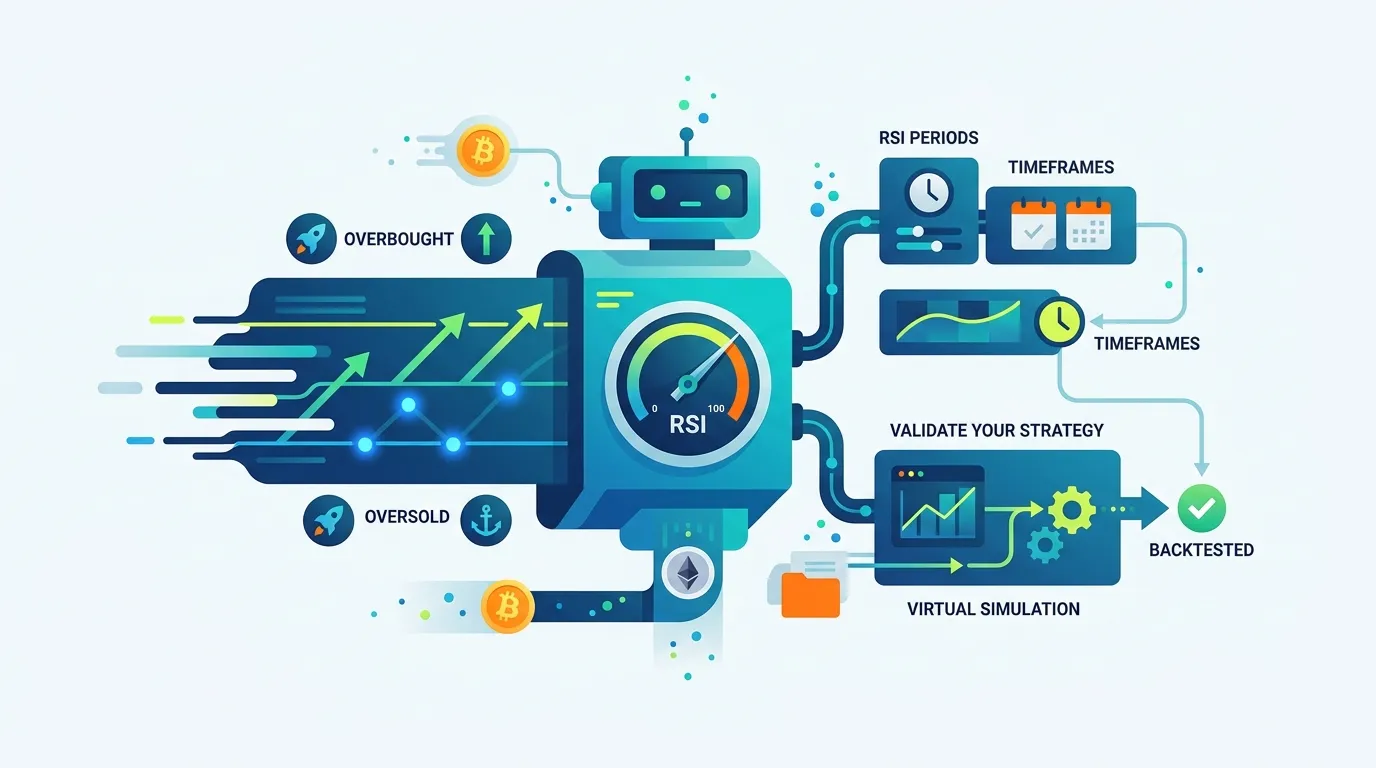
RSI Crypto Trading Bot: A Practical Build Guide
Learn how an RSI crypto trading bot detects overbought and oversold conditions, how to configure RSI periods and timeframes, and how to validate your strategy before going live.
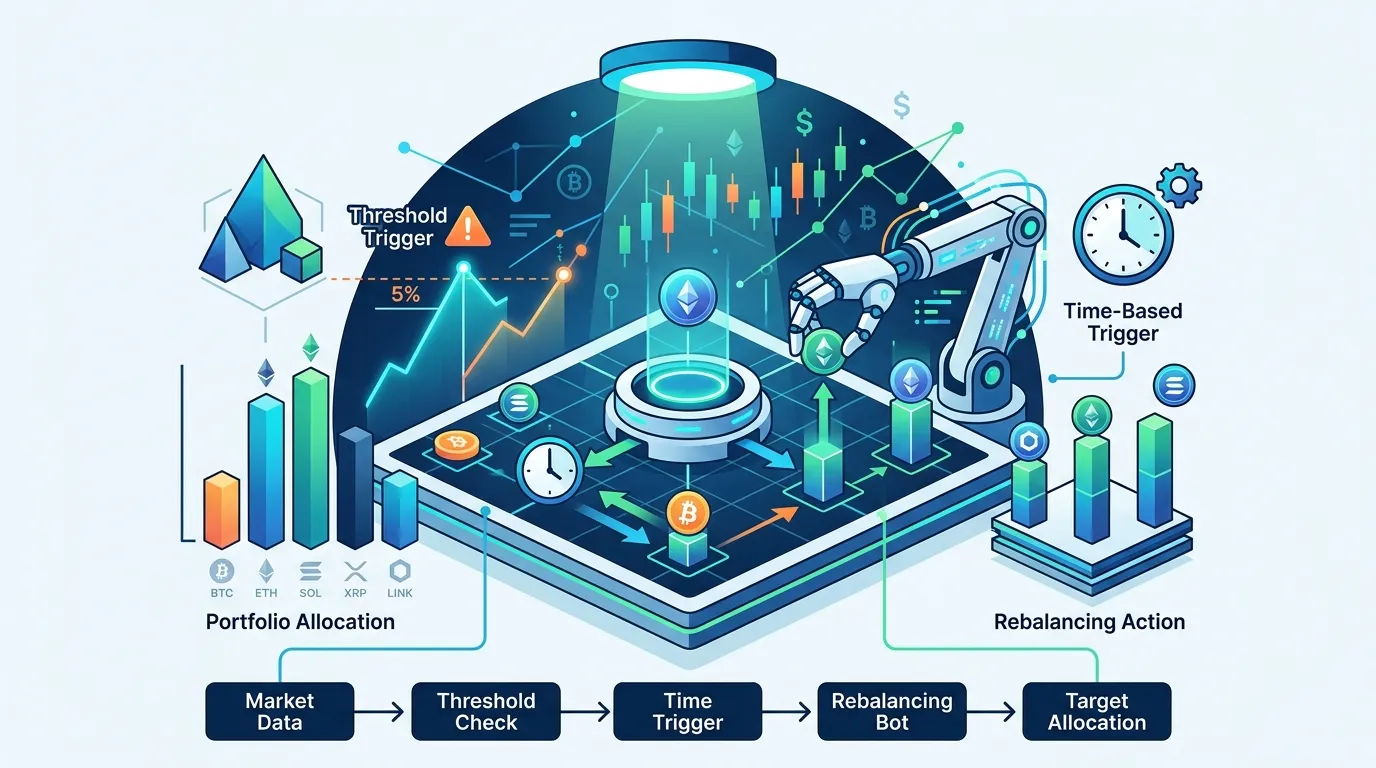
Crypto Portfolio Rebalancing Bot: A Complete Builder's Guide
Learn how to build a crypto portfolio rebalancing bot using threshold-based and time-based triggers to maintain target allocations automatically — without emotional bias or manual effort.

Crypto Grid Trading Bot: A Complete Setup Guide
Learn how a crypto grid trading bot works, how to configure price ranges and grid levels, and how to deploy one without writing a single line of code using an AI builder.