Crypto Portfolio Rebalancing Bot: A Complete Builder's Guide
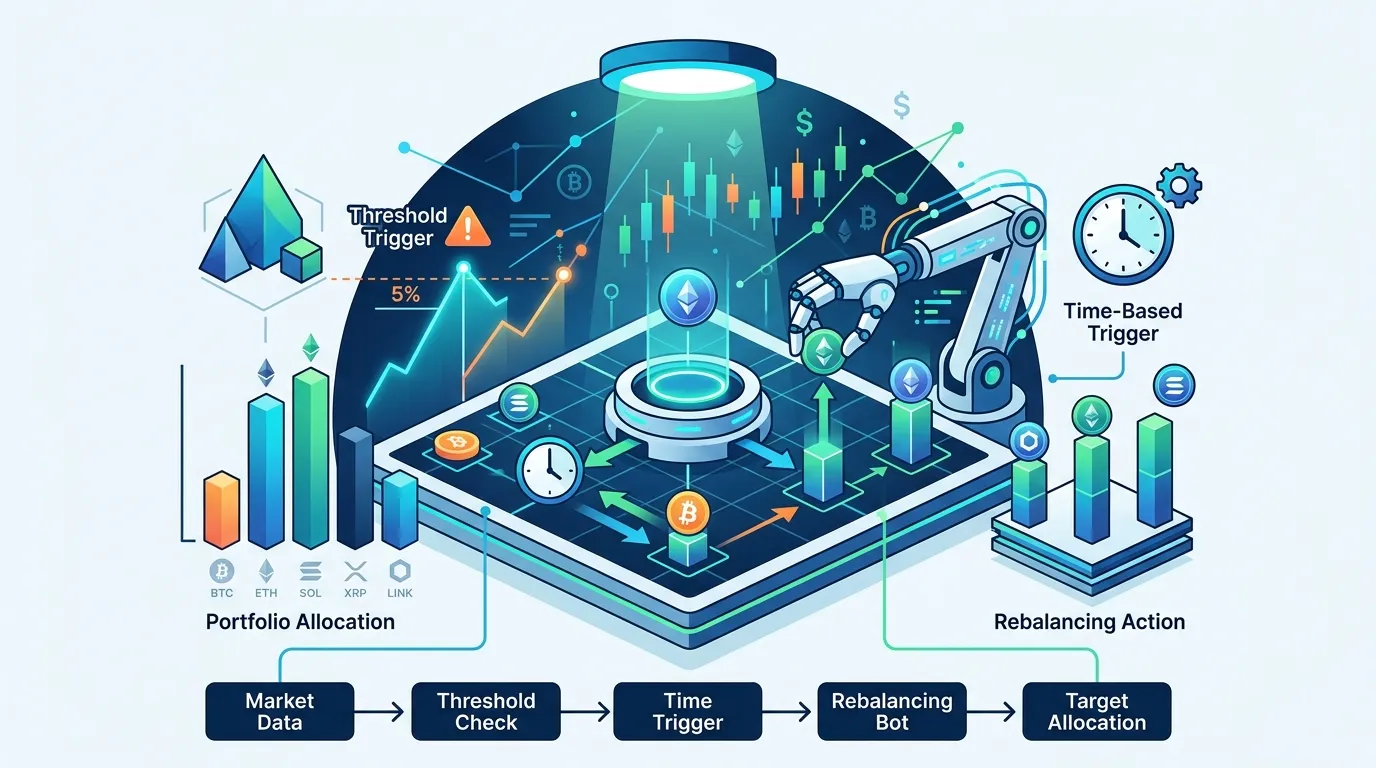
Holding a static crypto portfolio sounds simple until Bitcoin rallies 40% in two weeks and suddenly represents 70% of your total value instead of the 50% you planned. That concentration risk is portfolio drift — and in crypto, it compounds faster than in almost any other asset class. A crypto portfolio rebalancing bot solves this by continuously monitoring your allocations and trading back to target whenever a defined rule fires, removing the emotional friction that causes most manual rebalancers to procrastinate or panic.
A crypto portfolio rebalancing bot is software that compares your current asset weights against a set of predefined target allocations and automatically executes trades to restore those weights whenever a threshold-based or time-based trigger is met. It removes manual decision-making, enforces discipline, and can operate around the clock across exchanges that offer API access.
This guide walks you through how rebalancing bots work, the two dominant trigger strategies, the parameters that matter most, common pitfalls, and how tools like Cryptohopper.AI let you describe and deploy a custom rebalancer in plain language without writing exchange-integration code from scratch.
What Is a Crypto Portfolio Rebalancing Bot?
A crypto portfolio rebalancing bot is an automated program that reads live portfolio weights from an exchange, calculates the deviation from your target allocation, and places buy/sell orders to close that gap. Unlike a signal bot that chases price momentum, a rebalancing bot is allocation-first: it sells what has grown too large and buys what has shrunk, effectively enforcing a "sell high, buy low" discipline on a rules-based schedule.
"Rebalancing is not a return-maximization strategy — it is a risk-control mechanism that keeps your exposure profile consistent with your original intent."
The bot needs three data inputs at minimum: your current holdings (from the exchange API), your target weights (configured by you), and a fee schedule (to avoid trades that cost more than the rebalance saves).
How Does Automatic Crypto Portfolio Rebalancing Work?
Automatic rebalancing works by running a continuous or periodic loop:
- Fetch portfolio snapshot — Query the exchange API for current balances and convert everything to a base currency (usually USDT or BTC) to calculate percentage weights.
- Compare against targets — Subtract the current weight from the target weight for each asset. The result is the drift vector.
- Check trigger condition — Either the largest individual drift exceeds your threshold (e.g., ±5%) or the scheduled interval has elapsed (e.g., every 24 hours).
- Calculate trade sizes — Determine the minimum set of trades needed to restore all weights simultaneously, accounting for available liquidity and minimum order sizes.
- Execute orders — Place market or limit orders sequentially or in parallel, depending on exchange support and slippage tolerance.
- Log and alert — Record the rebalance event, the before/after weights, fees paid, and any failed fills for your dashboard review.
Steps 1–6 repeat on every tick or scheduled interval, meaning the bot is always "aware" of drift even when it doesn't trade.
Threshold-Based vs. Time-Based Rebalancing: Which Should You Use?
Both strategies enforce discipline but respond to market conditions differently. Choosing the right one — or combining them — depends on your portfolio size, fee structure, and volatility tolerance.
Threshold-Based Triggers
A threshold trigger fires when any single asset drifts beyond a set band, commonly ±5% of its target weight. If BTC is targeted at 40% and rises to 45.1%, the trigger fires.
Pros:
- Only trades when drift is meaningful, reducing unnecessary fee spend.
- Naturally more active in trending markets and quieter in flat ones.
- Tighter bands (±2–3%) provide stronger risk control; wider bands (±7–10%) minimize churn.
Cons:
- Can trigger many small trades in choppy, mean-reverting markets.
- Requires tuning per-asset, especially for high-volatility altcoins.
Time-Based Triggers
A time trigger fires on a fixed calendar interval — hourly, daily, weekly, or monthly — regardless of actual drift.
Pros:
- Predictable execution schedule; easier to reconcile with tax records.
- Avoids over-trading in noisy, choppy markets.
- Simpler to configure and audit.
Cons:
- May miss large intraday drift events between intervals.
- Weekly rebalances can allow significant concentration to build up in a fast-moving market.
Comparison: Threshold vs. Time-Based Rebalancing
| Dimension | Threshold-Based | Time-Based |
|---|---|---|
| Trigger condition | Asset weight drifts ±N% | Fixed calendar interval |
| Trade frequency | Market-driven (variable) | Fixed (predictable) |
| Fee efficiency | Higher in stable markets | Consistent regardless of conditions |
| Risk control speed | Faster reaction to trends | Slower; depends on interval |
| Complexity | Higher (per-asset bands) | Lower |
| Best for | Volatile, trending markets | Stable, long-term portfolios |
Many production bots use a hybrid rule: rebalance on the weekly schedule or if any asset exceeds ±5% drift, whichever comes first.
Key Parameters to Configure Before You Launch
Getting these parameters wrong is more dangerous than choosing the "wrong" strategy.
- Target weights — Must sum to 100%. Start with a small number of assets (3–6) to keep trade logic clean.
- Rebalance band (threshold) — A ±5% band on a 40% BTC target means trading fires below 35% or above 45%. Narrower bands mean more trades and more fees.
- Minimum trade size — Most exchanges enforce a minimum notional order size (e.g., $10). Set your bot's floor above this to avoid rejected orders.
- Fee-aware threshold — If your expected rebalance trade is worth $8 in drift correction but costs $6 in fees, the trade destroys value. Build a net-benefit check: only trade if
drift_value_corrected > fee_cost × safety_multiplier. - Base currency — Decide whether you rebalance into/out of USDT, BTC, or another stable asset. This affects how the bot handles a market-wide drawdown.
- Slippage tolerance — For low-liquidity assets, the spread between bid and ask can eat rebalance gains. Set a maximum acceptable slippage (e.g., 0.3%) and abort if exceeded.
"A rebalancing bot configured without a fee-aware threshold will silently erode returns one small trade at a time — fees are the hidden tax on over-engineering."
How Often Should You Rebalance a Crypto Portfolio?
There is no universally optimal frequency. Academic research on traditional assets (e.g., from Vanguard's studies on bond/equity portfolios) suggests annual or threshold-based rebalancing outperforms more frequent approaches on a fee-adjusted basis. In crypto, higher volatility shifts the calculus: a ±5% threshold or a weekly interval is a commonly cited starting point in the crypto community, with tighter thresholds reserved for larger portfolios where the absolute dollar value of drift justifies the trade cost. Always model your expected fee spend before going live.
Is Crypto Portfolio Rebalancing Profitable?
Rebalancing is a risk-management tool, not a return-enhancement strategy, and it carries substantial risk like all crypto activity. In backtests on portfolios containing both high-growth and stable assets, threshold-based rebalancing has historically reduced volatility and maximum drawdown compared to buy-and-hold — but past backtest performance does not predict future results. Whether rebalancing improves or reduces nominal returns depends heavily on whether the market trends or mean-reverts during the period. In a strongly trending market (e.g., BTC dominance rising all year), rebalancing systematically sells the winner and may underperform a static portfolio. Approach rebalancing as a discipline for managing your intended risk exposure, not as a signal that profits are guaranteed.
What Are the Tax Implications of Automatic Crypto Rebalancing?
In most jurisdictions — including the United States (per IRS guidance), the United Kingdom, Canada, and Australia — each rebalance trade is a taxable disposal event. Selling BTC to buy ETH triggers a capital gain or loss based on the difference between your cost basis and the sale price at the time of execution. A bot that rebalances weekly could generate 52 × (number of assets) taxable events per year.
Key actions to take:
- Track cost basis from day one — Use FIFO, LIFO, or average-cost accounting consistently. Many jurisdictions require FIFO.
- Export trade logs — Ensure your bot records timestamp, asset pair, quantity, price, and fee for every order.
- Consult a tax professional — Crypto tax law is jurisdiction-specific and evolving. Nothing in this article is tax advice.
Building a Rebalancing Bot with Cryptohopper.AI
Instead of writing exchange integration code from scratch, you can describe your rebalancing tool in plain language on Cryptohopper.AI. The platform generates and deploys the application automatically, connecting to your Cryptohopper account via OAuth so the app can read portfolio data and place orders securely through your existing exchange connections. Project secrets — including any API credentials — are encrypted at rest and injected at runtime, never exposed in generated code.
A plain-language description like "Build a portfolio dashboard that fetches my Cryptohopper holdings every 15 minutes, displays current vs. target weights for BTC/ETH/SOL/USDT, highlights assets drifting more than 5%, and shows a rebalance log with fees paid" is enough to get a working app deployed to a <yourproject>.cryptohopper.app subdomain. You can then iterate on the prompt — adding a weekly time trigger, a fee-benefit check, or a P&L impact chart — and the platform redeploys continuously as you refine. Note that building requires an active Cryptohopper subscription, which includes monthly AI Credits.
Common Pitfalls to Avoid
- Over-rebalancing in choppy markets — A ±2% band on a volatile altcoin can trigger dozens of trades in a sideways week. Widen bands or add a minimum-time-between-trades cooldown.
- Ignoring cumulative fees — A 0.1% maker fee sounds trivial, but 3 trades per day across 5 assets = 1,095 fee events per year. Model total annual fee drag before setting any threshold.
- Including illiquid assets — Low-volume tokens have wide spreads and thin order books. A rebalance order can move the market against itself. Stick to assets with sufficient 24-hour volume relative to your trade size.
- No minimum trade-size floor — Rejected micro-orders create log noise and can desynchronize your bot's internal state from actual exchange balances.
- Skipping a paper-trading phase — Run the bot in read-only mode (log planned trades without executing) for at least one to two weeks before going live. Verify the logic against your expectations.
- Treating backtest results as forward guarantees — Overfitted parameters (e.g., a threshold tuned perfectly to historical data) rarely perform as expected in live markets.
Wrapping Up
A well-configured crypto portfolio rebalancing bot enforces allocation discipline without emotional interference, keeping your risk profile consistent even as individual assets surge or crash. The key is choosing the right trigger strategy for your portfolio's volatility, setting fee-aware thresholds, and maintaining detailed trade logs for tax compliance. Build incrementally, paper-trade first, and treat every rebalance event as a data point — not a guaranteed profit. The automation handles the mechanics; the strategy design remains your responsibility.
Frequently asked questions
What is a crypto portfolio rebalancing bot?
A crypto portfolio rebalancing bot is automated software that monitors your current asset weights against predefined target allocations and executes trades to restore those weights whenever a trigger fires — either when drift exceeds a threshold (e.g., ±5%) or when a scheduled time interval elapses (e.g., weekly). It connects to your exchange via API, calculates the minimum trades needed, and executes them without manual intervention.
How does automatic crypto portfolio rebalancing work?
The bot periodically fetches your exchange balances, converts all holdings to a common base currency, calculates each asset's current weight, and compares it against your target. If a threshold or time trigger is met, it computes the buy and sell orders needed to close the gap, executes them, and logs the event. The cycle then repeats on the next tick or scheduled interval.
How often should you rebalance a crypto portfolio?
There is no single correct answer. A commonly cited starting point in crypto is a ±5% drift threshold or a weekly time-based trigger — or a hybrid of both. More frequent rebalancing increases fee costs without necessarily improving outcomes. The right frequency depends on your portfolio size (larger portfolios justify smaller thresholds because the absolute dollar drift is larger), the volatility of your assets, and your exchange fee structure.
Is crypto portfolio rebalancing profitable?
Rebalancing is primarily a risk-management discipline, not a return-maximization strategy, and all crypto trading carries substantial risk of loss. In historically mean-reverting markets it can reduce drawdowns and volatility compared to buy-and-hold. In strongly trending markets it may underperform a static portfolio by systematically selling the winning asset. Backtest results do not guarantee future performance. Always account for trading fees in any profitability analysis.
What are the tax implications of automatic crypto rebalancing?
In most major jurisdictions — including the US, UK, Canada, and Australia — each rebalance trade is a taxable disposal event that may generate a capital gain or loss. A bot rebalancing weekly across five assets could produce hundreds of taxable events per year. You must track cost basis (acquisition price) for every unit sold, export detailed trade logs, and consult a qualified tax professional familiar with crypto in your jurisdiction. This article does not constitute tax advice.
Subscribe to the Cryptohopper newsletter
New posts, product updates, and the occasional lesson — straight to your inbox.
We'll never share your email. Unsubscribe anytime.
Related articles

Crypto Grid Trading Bot: A Complete Setup Guide
Learn how a crypto grid trading bot works, how to configure price ranges and grid levels, and how to deploy one without writing a single line of code using an AI builder.

DCA Crypto Trading Bot: A Complete Builder's Guide
Learn how a DCA crypto trading bot works, which parameters matter most, how to set smart entry conditions, and how to build and deploy one using plain-language AI tools.
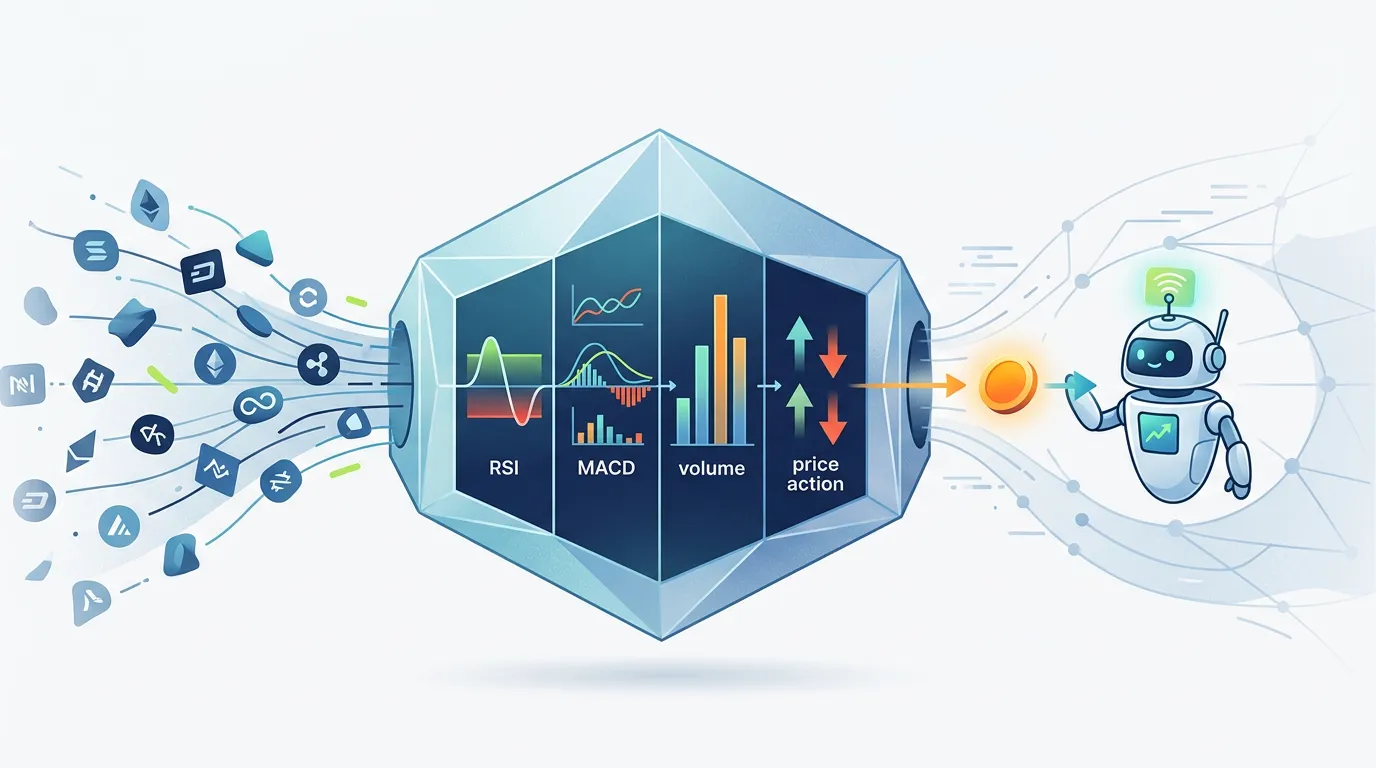
Crypto Market Screener for Trading Bots: A Practical Build Guide
Learn how to build a custom crypto market screener that filters assets by RSI, MACD, volume, and price action to surface clean bot entry signals before automated orders fire.