Crypto Portfolio Rebalancing Bot: A Complete Builder's Guide

Crypto markets move fast, and even a well-planned allocation can drift wildly within days. If you started with 40% BTC, 30% ETH, and 30% altcoins, a single bull run in one asset can leave you massively overexposed without you ever making a conscious decision. A crypto portfolio rebalancing bot solves that problem by continuously monitoring your holdings and executing corrective trades the moment allocations stray beyond a defined tolerance — no spreadsheet refreshing, no manual order entry required.
This guide walks you through how these bots work, the two core strategies behind them, the parameters you need to define, and how to build one from scratch even if you've never written a line of code.
How Does a Crypto Portfolio Rebalancing Bot Work?
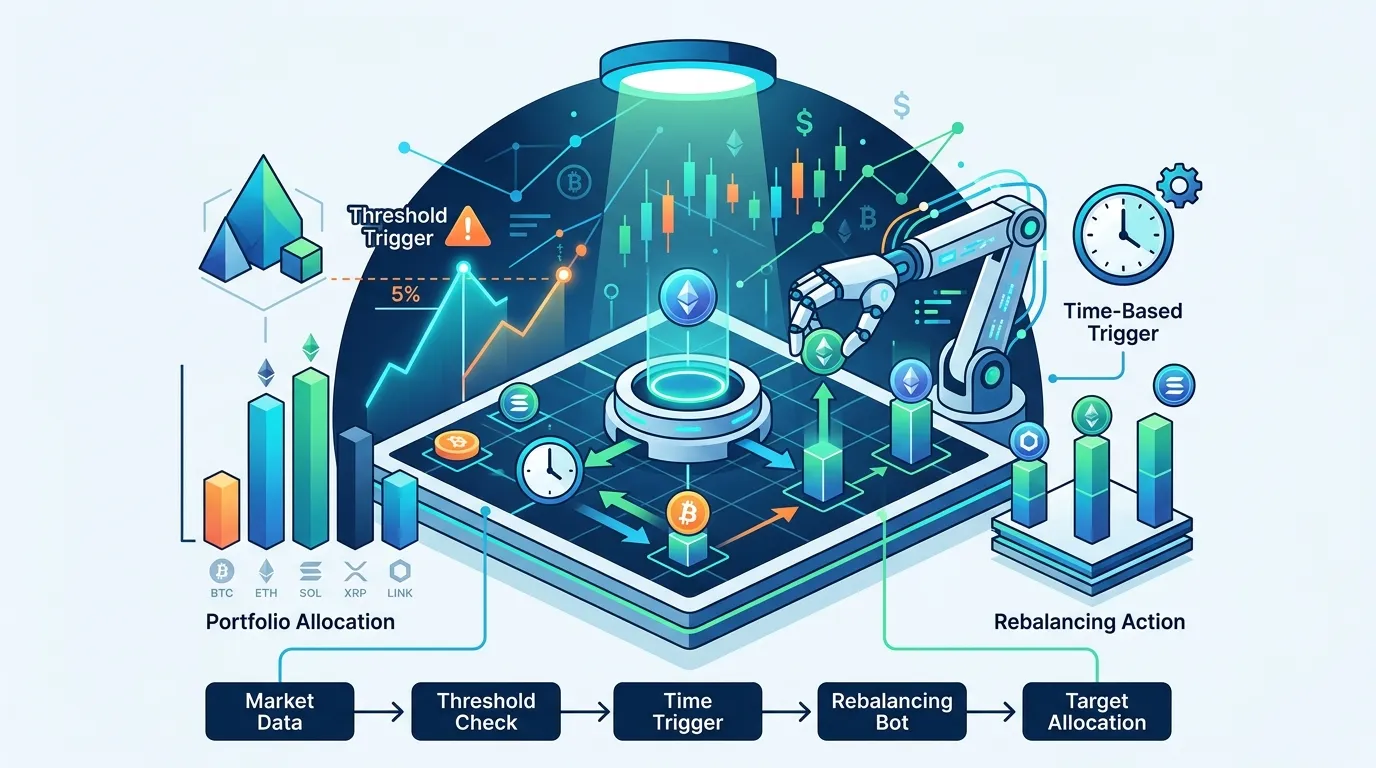
A crypto portfolio rebalancing bot tracks the current market value of each asset in your portfolio, calculates each asset's weight as a percentage of total portfolio value, and compares that weight against a predefined target. When the deviation exceeds a configured threshold — say, ±5% — the bot places sell orders on over-weight assets and buy orders on under-weight ones until the portfolio returns to its target state. The entire cycle runs automatically, typically against exchange APIs, without requiring manual intervention.
The core loop is simple: measure → compare → trade → repeat. Complexity lives in the parameters you set, not in the concept itself.
Why Crypto Portfolios Drift: Volatility and Uneven Gains
In traditional finance, a 60/40 stock-bond portfolio might drift a few percentage points over a quarter. In crypto, a 24-hour price move of 20–30% on a single asset is routine. This creates drift — the gap between your intended allocation and your actual one.
Drift has two practical consequences:
- Concentration risk increases. A "diversified" portfolio silently becomes a single-asset bet as the winner snowballs.
- Profit stays unrealised. Gains sit in the appreciated asset rather than being distributed across your strategy.
Rebalancing mechanically sells some of what has run up and buys what has lagged — a systematic way to enforce "buy low, sell high" discipline without relying on prediction or emotion.
Two Core Rebalancing Strategies: Threshold vs. Time-Based
Threshold-Based Rebalancing (Event-Driven)
The bot fires only when an asset drifts beyond a set percentage from its target weight. For example: rebalance any asset that moves more than ±5% from its target.
Advantages: Trades happen only when drift is meaningful, keeping transaction costs lower during calm markets. More responsive to sudden volatility.
Considerations: In a choppy sideways market, it can trigger frequent small trades if the threshold is set too tight.
Time-Based Rebalancing (Calendar-Driven)
The bot rebalances on a fixed schedule — daily, weekly, or monthly — regardless of how much drift has occurred.
Advantages: Predictable and easy to reason about. Useful when you want consistent, auditable behaviour.
Considerations: Can trigger unnecessary trades when the portfolio is already close to target, accumulating fees for little benefit.
| Feature | Threshold-Based | Time-Based |
|---|---|---|
| Trigger | Drift exceeds X% | Fixed interval (e.g. weekly) |
| Trade frequency | Variable, market-driven | Fixed, schedule-driven |
| Fee efficiency | Higher (trades when needed) | Lower (trades on schedule) |
| Responsiveness to volatility | High | Low |
| Complexity to configure | Moderate | Low |
Most practitioners combine both: a threshold trigger to catch big moves quickly, plus a time-based fallback to handle slow creep that never quite crosses the threshold.
Key Parameters to Define Before You Build
Before writing a single line of bot logic, nail down these four variables:
- Target weights — The percentage of total portfolio value each asset should represent (e.g. BTC 40%, ETH 30%, SOL 20%, USDC 10%). Weights must sum to 100%.
- Drift tolerance — The maximum allowed deviation before a rebalance fires. A common starting point is ±5%; tighter tolerances (±2%) create more trades and higher fees.
- Minimum trade size — The smallest order the bot will place. Setting a floor (e.g. $10 or 0.001 BTC) prevents the bot from placing dust orders that exchanges reject or that cost more in fees than they're worth.
- Supported exchange pairs — Not every asset pairs directly against every other. Your bot needs a routing strategy: does it sell everything to a stablecoin first, then rebuy? Or does it trade cross-pairs where liquidity allows?
Getting these parameters right matters more than the code itself. A bot with perfect logic and wrong parameters will still trade poorly.
Can You Build Your Own Crypto Portfolio Rebalancing Bot?
Yes — and you don't need to be a developer to do it. Platforms like Cryptohopper.AI let you describe the bot you want in plain language, then generate, deploy, and host the code automatically.
Here's how the process works in practice:
- Describe your bot in plain language. For example: "Build a portfolio rebalancing bot that monitors BTC, ETH, and SOL. Target weights are 50%, 30%, and 20%. Rebalance whenever any asset drifts more than 5% from its target. Ignore trades smaller than $15."
- Connect your Cryptohopper account via OAuth. Cryptohopper.AI integrates with Cryptohopper (the trading platform at cryptohopper.com) securely through OAuth, so your generated bot can access live exchange data and place orders without your API keys ever appearing in generated code. Secrets are encrypted at rest and injected at runtime.
- Iterate with natural language. If you want to add a time-based fallback, add a dashboard, or adjust thresholds, you describe the change and the platform regenerates the relevant logic.
- Auto-deployment. Your project deploys immediately to a
<your-project>.cryptohopper.appsubdomain. There's no manual deploy step — each iteration is live as soon as it's generated.
Pair the bot with a real-time P&L dashboard (also buildable via Cryptohopper.AI) that displays current vs. target allocations as live gauges or charts, shows a timestamped rebalancing history, and highlights which assets are currently over or under their target weight. Visual feedback makes it far easier to catch misconfigured parameters early.
Is Automated Crypto Rebalancing Profitable?
Automated rebalancing is not an alpha-generating strategy in the traditional sense — it doesn't predict price direction. What it does is enforce discipline: systematically trimming positions that have outperformed and adding to those that have underperformed, relative to your targets.
Academic research on traditional portfolios (and practitioner experience in crypto) suggests rebalancing can improve risk-adjusted returns compared to a buy-and-hold approach in high-volatility, mean-reverting markets. However, results depend heavily on fees, slippage, market regime, and chosen parameters. In a strong trending market, rebalancing repeatedly sells the winner and can underperform a pure hold.
The honest framing: rebalancing is a risk-management tool first, a return-enhancement tool second. Crypto trading carries substantial risk of loss — automated or not.
What Are the Risks of Using a Crypto Rebalancing Bot?
Understanding the risks is as important as understanding the mechanics:
- Transaction fees accumulate. Every rebalancing trade incurs a fee. A drift tolerance set too tight on a volatile asset can generate dozens of trades per day, eroding returns.
- Slippage on low-liquidity pairs. Small-cap assets with thin order books mean the price you see isn't always the price you get. Set minimum trade sizes and test with realistic order sizes before going live.
- API and connectivity risk. If the bot loses connection to the exchange mid-rebalance, you may be left in a partially rebalanced state. Robust error handling and alerts are essential.
- Incorrect parameters. Wrong target weights or a misrouted trade path can cause the bot to do the opposite of what you intend.
- Market regime mismatch. Threshold rebalancing in a trending market repeatedly sells the best-performing asset. Understand the strategy's behaviour before deploying real capital.
Best practice: run your bot in paper-trading mode first. Observe how often it fires, what size trades it places, and whether the resulting allocation matches your expectations — all without real money at risk.
How Often Should You Rebalance a Crypto Portfolio?
There's no universally correct answer, but here are evidence-based guidelines:
- Threshold-based triggers (±5%) approximate monthly rebalancing frequency during typical crypto volatility, without requiring calendar discipline.
- Tighter thresholds (±2–3%) can mean daily or even multiple-times-daily trades on volatile assets — useful for active traders who prioritise tight allocation control but accept higher fees.
- Wider thresholds (±10%) approximate quarterly rebalancing and suit investors who want minimal interference and lower transaction costs.
- Time-based fallback: a weekly or monthly check catches slow drift that never quite hits a percentage threshold.
The right frequency is the one that balances your tolerance for drift against your tolerance for trading costs.
Wrapping Up
A crypto portfolio rebalancing bot turns a reactive manual chore into a systematic, always-on process. Define your target weights, choose a drift threshold, set a sensible minimum trade size, and validate everything in paper-trading mode before going live. If you want to build one without writing code, Cryptohopper.AI lets you describe your bot in plain language, connects securely to your Cryptohopper account via OAuth, and deploys everything automatically. Start simple, observe behaviour, and refine — the parameters matter more than the complexity of the code.
Frequently asked questions
How does a crypto portfolio rebalancing bot work?
A crypto portfolio rebalancing bot continuously tracks the market value of each asset in your portfolio, calculates each asset's current weight as a percentage of total portfolio value, and compares that against a predefined target. When any asset's weight drifts beyond a set tolerance (for example, ±5%), the bot automatically sells over-weight assets and buys under-weight ones to restore the target allocation — all via your exchange's API.
What is the best crypto portfolio rebalancing bot?
The best bot depends on your goals. If you want a pre-built product, platforms like Cryptohopper (cryptohopper.com) offer established rebalancing features. If you want a custom bot tailored to your exact parameters — specific assets, thresholds, and logic — Cryptohopper.AI (cryptohopper.ai) lets you describe and build one in plain language without writing code. There is no one-size-fits-all answer; prioritise the platform that matches your technical comfort level and strategy complexity.
Is automated crypto rebalancing profitable?
Automated rebalancing is primarily a risk-management tool, not a guaranteed profit strategy. It enforces discipline by systematically trimming outperformers and adding to underperformers relative to your targets. In high-volatility, mean-reverting markets it can improve risk-adjusted returns compared to a pure buy-and-hold approach, but in strong trending markets it may underperform by repeatedly selling the best-performing asset. Transaction fees and slippage also eat into any benefit. Crypto trading carries substantial risk of loss regardless of automation.
How often should you rebalance a crypto portfolio?
With threshold-based rebalancing, frequency is driven by market volatility rather than a calendar. A ±5% drift tolerance typically approximates monthly rebalancing frequency during normal crypto market conditions. Tighter tolerances (±2–3%) can trigger daily trades; wider tolerances (±10%) approximate quarterly activity. Many practitioners combine a threshold trigger with a time-based fallback (e.g. weekly) to catch slow drift that never quite crosses the percentage threshold.
What are the risks of using a crypto rebalancing bot?
Key risks include: accumulating transaction fees if the drift tolerance is set too tight; slippage on low-liquidity or small-cap assets where the execution price differs from the quoted price; connectivity or API failures that leave the portfolio in a partially rebalanced state; and misconfigured parameters that cause unintended trading behaviour. Always validate bot logic in paper-trading mode before deploying real capital, and set a minimum trade size to avoid costly dust orders.
Can you build your own crypto portfolio rebalancing bot?
Yes. You can build a custom rebalancing bot without any coding experience using Cryptohopper.AI (cryptohopper.ai). You describe your desired logic in plain language — target weights, drift thresholds, minimum trade sizes — and the platform generates and deploys the bot automatically. It connects to your exchange via your Cryptohopper account using OAuth, keeping API credentials secure. You can also pair the bot with a real-time dashboard to visualise current versus target allocations and track rebalancing history.
Subscribe to the Cryptohopper newsletter
New posts, product updates, and the occasional lesson — straight to your inbox.
We'll never share your email. Unsubscribe anytime.
Related articles
Crypto Portfolio Rebalancing Bot: A Complete Builder's Guide
Learn how to build a crypto portfolio rebalancing bot using threshold-based and time-based triggers to maintain target allocations automatically — without emotional bias or manual effort.

How to Build a Crypto Price Alert Bot That Monitors RSI and Bollinger Bands
Learn how to build a crypto price alert bot that monitors RSI overbought/oversold levels, Bollinger Band breakouts, and MACD changes — and fires real-time notifications before a trade signal is acted upon.

Crypto Grid Trading Bot: A Complete Setup Guide
Learn how a crypto grid trading bot works, how to configure price ranges and grid levels, and how to deploy one without writing a single line of code using an AI builder.