Crypto Market Screener Bot: Bollinger Band Squeeze & Volume Spike Guide
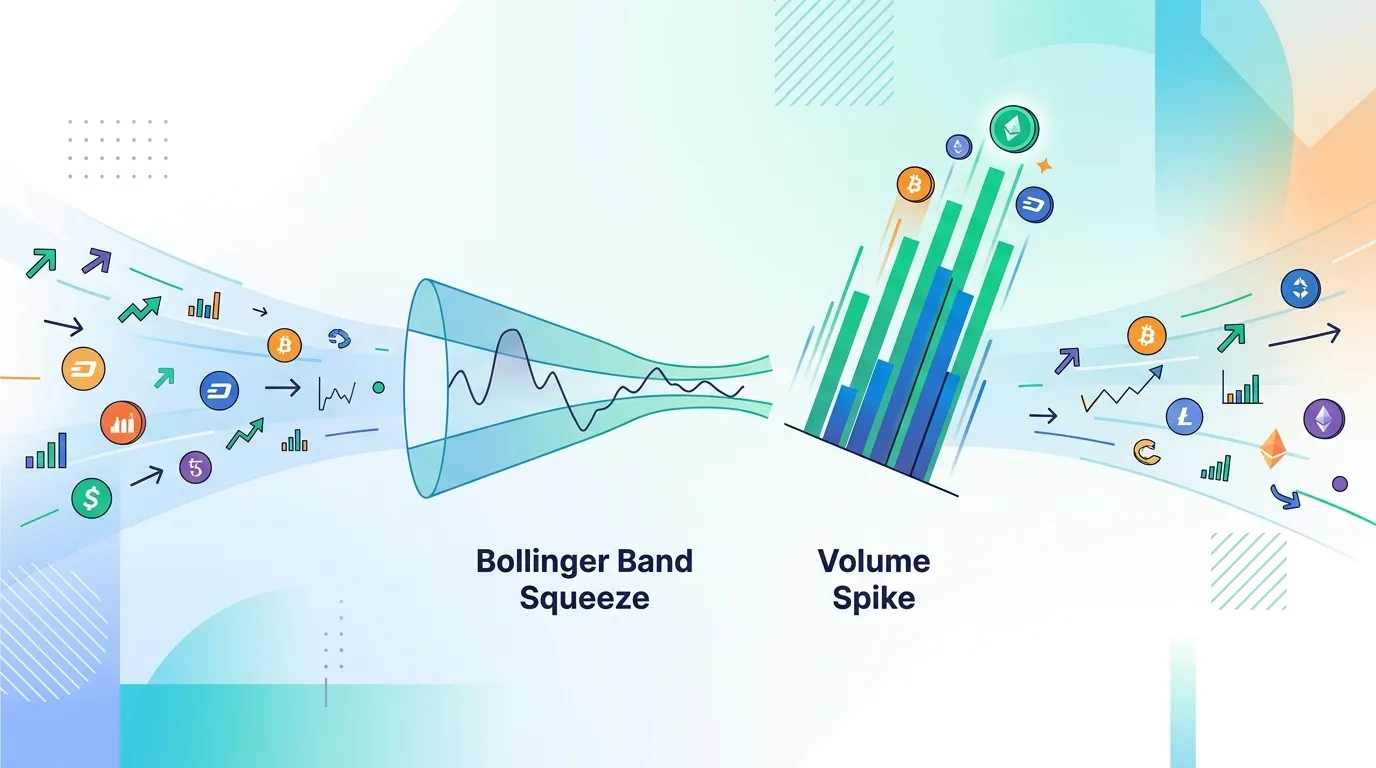
Scanning hundreds of crypto pairs manually for the right setup is a losing battle — the market moves faster than any human can keep up. A crypto market screener bot changes that equation by doing the heavy lifting automatically, flagging only the coins that meet your exact technical criteria in real time. This guide walks you through building one that specifically hunts for Bollinger Band squeezes confirmed by volume spikes — one of the most widely watched volatility-breakout combinations in technical analysis.
What Is a Crypto Market Screener Bot?
A crypto market screener bot is an automated tool that continuously scans a defined universe of cryptocurrency pairs — sometimes hundreds at once — and applies one or more technical filters to surface coins matching a specific setup. Instead of manually pulling up charts, a screener does the pattern recognition for you and presents only the candidates worth a closer look. Common filters include indicator thresholds (RSI, MACD, Bollinger Bands), volume conditions, price-range rules, and trend-alignment checks. The bot refreshes on a configurable schedule so the output always reflects current market conditions.
A screener doesn't tell you what to trade — it tells you where to look. The final decision, and all the risk that comes with it, always rests with you. Crypto trading carries substantial risk of loss.
Why Manual Coin-Scanning Fails at Scale
There are roughly 600+ perpetual futures markets on a major exchange like Binance alone. Even a focused trader monitoring 50 pairs cannot realistically check each chart on a 15-minute timeframe without missing setups or making errors from fatigue. The problems compound:
- Speed: A squeeze can form and break out within two candles. Manual checks introduce lag.
- Consistency: Human scanners apply criteria inconsistently, especially under pressure.
- Coverage: More coins mean more opportunity — but also more noise. A bot applies the same rules uniformly to every asset in your watchlist, every single time.
Automating the scan with a bot solves all three issues simultaneously and frees you to focus on evaluating and sizing the setups that actually appear.
Understanding the Bollinger Band Squeeze Signal
Bollinger Bands consist of a simple moving average (SMA) and two bands plotted at ±2 standard deviations from it. When market volatility contracts — during a consolidation phase — the upper and lower bands narrow toward the middle line. This narrowing is called a Bollinger Band squeeze.
Why the Squeeze Matters
The squeeze itself is not a directional signal. What it identifies is a coiling period of compressed energy. Historically, prolonged low-volatility regimes in liquid markets tend to resolve into a sharper move in one direction. The squeeze tells you: something may be coming. How narrow is narrow enough? A common rule of thumb is flagging pairs where the Bandwidth indicator (calculated as (Upper Band − Lower Band) / Middle Band) drops to its lowest reading over the past 20–125 candles, depending on your timeframe.
Measuring the Squeeze Programmatically
Your screener can calculate Bollinger Bandwidth for every pair on each candle close, then rank or filter pairs where Bandwidth is at or near an N-period low. Typical parameters:
| Parameter | Conservative | Aggressive |
|---|---|---|
| SMA period | 20 | 20 |
| Standard deviations | 2.0 | 1.5 |
| Bandwidth lookback (candles) | 125 | 20 |
| Timeframe | 1H or 4H | 15M |
Adding Volume Spike Detection to Reduce False Positives
A Bollinger Band squeeze alone generates false signals — sometimes price drifts sideways through the bands without any real breakout. Volume is the confirmation layer that separates genuine breakouts from noise.
A volume spike is typically defined as the current candle's volume exceeding a multiple of the average volume over a rolling lookback window. Common thresholds:
- Calculate the 20-period rolling average volume for each pair.
- Flag the pair if the latest candle's volume is ≥ 1.5× (conservative) or ≥ 2× (aggressive) that average.
- Require both conditions — squeeze AND spike — to be true simultaneously before surfacing the coin.
Requiring squeeze + volume confirmation before raising an alert has the effect of dramatically narrowing the output list. Fewer, higher-quality candidates mean you spend less time filtering noise and more time evaluating real setups.
This combined filter is more powerful than either signal alone. A squeeze with no volume may just be a weekend drift. Volume surging into a squeeze typically signals that participants are stepping in — whether buyers or sellers — and a resolution of the consolidation is imminent.
How Do I Build a Crypto Screener Bot?
Building a crypto screener bot from scratch requires connecting to exchange APIs, calculating indicators across multiple assets in parallel, handling rate limits, and serving the results through a usable interface. For developers comfortable with Python or Node.js, libraries like ccxt (for exchange connectivity) and ta-lib or pandas_ta (for indicator math) provide the building blocks. You'd typically:
- Fetch OHLCV data for each pair on your target exchange via REST or WebSocket.
- Compute Bollinger Bandwidth and rolling volume averages per pair.
- Apply your filter logic (squeeze threshold AND volume spike).
- Output results to a dashboard, console, or alert channel (e.g., Telegram, Discord webhook).
- Schedule reruns every candle close or at a fixed interval.
Building Without Code Using Cryptohopper.AI
If you'd rather describe what you want in plain English and let AI write the implementation, Cryptohopper.AI is built for exactly this. You connect your Cryptohopper account via OAuth, then type a prompt like:
"Build a crypto market screener that pulls 1H OHLCV data for the top 100 USDT pairs, calculates Bollinger Bandwidth with a 20-period SMA and 2 standard deviations, flags pairs where Bandwidth is at a 125-candle low, and cross-checks with a volume spike filter where volume exceeds 1.5× the 20-candle average. Display results in a sortable table showing pair name, current bandwidth, volume ratio, and last candle close. Refresh every 15 minutes."
Cryptohopper.AI generates the application code and deploys it automatically to a live dashboard at a <your-project>.cryptohopper.app URL — no build steps, no deploy button, no server configuration. Your project's API credentials are encrypted at rest and injected at runtime, so they never appear in generated code or logs.
Which APIs Are Used for Crypto Market Screener Bots?
The most common API choices are:
- Exchange REST/WebSocket APIs (Binance, Coinbase Advanced, Kraken, Bybit) — direct OHLCV and trade data, lowest latency, but requires per-exchange integration.
- CCXT — an open-source library unifying 100+ exchange APIs under a single interface; the standard choice for multi-exchange screeners.
- CoinGecko / CoinMarketCap APIs — better for price/market-cap metadata and global screener filters, not ideal for candle-by-candle indicator math.
- TradingView's Pine Script — a sandboxed scripting environment for screeners that stay inside TradingView's ecosystem.
For a Bollinger Band screener, you need reliable OHLCV candle data. Exchange APIs or CCXT are typically the right tool.
How to Read and Act on Screener Output
Once your screener is running, the output table typically shows columns like: pair name, current bandwidth value, N-period bandwidth rank, volume ratio, and last candle close price. Here's how to use it:
- Sort by bandwidth rank ascending to see the tightest squeezes at the top.
- Look for volume ratios ≥ 1.5 as a secondary sort or hard filter.
- Open the chart for top candidates to visually confirm the setup context — is price near a key support/resistance? Is the broader trend aligned?
- Set alert thresholds inside your screener to notify you (via webhook, email, or on-screen) when new pairs meet the criteria, so you don't need to stare at the dashboard.
The screener surfaces candidates. It does not make trading decisions, and it carries no guarantee of outcome. Always apply your own judgment and risk management.
Can a Crypto Screener Bot Automate Trading Signals?
A screener bot identifies setups but does not, by itself, place orders. It becomes a signal generator when its output is piped into a trading bot that acts on those signals — for example, sending a webhook to a Cryptohopper bot configured to open a position when a squeeze + volume spike flag appears. This separation is intentional: the screener handles detection, the trading bot handles execution, and you handle risk parameters (position size, stop-loss, take-profit). Keeping these concerns separate makes each component easier to audit and tune independently.
Tips for Iterating on Your Screener
Getting the first version running is the beginning, not the end. Here's how to sharpen it over time:
- Adjust the lookback period. A 125-candle bandwidth lookback on the 1H chart gives longer-term context; dropping to 20 candles surfaces faster-forming squeezes that may fit shorter trading styles.
- Layer RSI. Adding a condition that RSI is between 45–55 (near midpoint, neither overbought nor oversold) at the time of the squeeze can further filter out setups already extended in one direction.
- Avoid over-filtering. Adding five or six simultaneous conditions can reduce your output list to zero. Start with two conditions (squeeze + volume), validate the signal quality over a few weeks, then add a third.
- Test on different timeframes. A squeeze on the 4H chart carries more weight than one on the 5M chart. Run parallel screeners on different timeframes and note which produces more reliable setups for your style.
- Log false positives. Keep a simple log of flagged pairs that did not follow through. Patterns in false positives (e.g., always on low-cap altcoins, always on weekends) guide parameter refinements.
Is a Crypto Screener Bot Profitable for Trading?
A screener bot is a tool for finding setups, not a profitability engine. Whether acting on the setups it surfaces is profitable depends entirely on the broader strategy, position sizing, risk management, and market conditions — not on the screener itself. A well-tuned screener reduces time wasted on low-quality charts and improves the signal-to-noise ratio of your workflow. That has real value. But crypto markets carry substantial risk of loss, and no screener, indicator combination, or automation removes that risk. Treat screener output as a starting point for analysis, not a buy/sell directive.
Wrapping Up
A crypto market screener bot built around the Bollinger Band squeeze and volume spike combination gives you a systematic, scalable way to surface volatility setups across a large coin universe without manual chart-hopping. The core logic is straightforward — narrow the bands, confirm with volume — but the real value comes from disciplined iteration and honest logging of what works. If you want to get a working screener dashboard deployed quickly without writing infrastructure code, Cryptohopper.AI lets you describe it in plain language and handles the rest automatically.
Frequently asked questions
What is a crypto market screener bot?
A crypto market screener bot is an automated tool that scans a defined list of cryptocurrency pairs, applies technical filters (such as Bollinger Band squeeze or volume spike thresholds), and surfaces only the coins that match your criteria — replacing slow, error-prone manual chart review.
How do I build a crypto screener bot?
You can build one by fetching OHLCV data from an exchange API (or using the CCXT library for multi-exchange support), calculating your indicators (e.g., Bollinger Bandwidth, rolling average volume), applying filter logic, and outputting results to a dashboard or alert channel. Alternatively, Cryptohopper.AI lets you describe the screener in plain language and auto-deploys a working dashboard without manual coding.
What are the best crypto screener bots available?
Popular options include TradingView's built-in screener (great for manual filtering within the TradingView ecosystem), custom Python/Node.js bots using CCXT for exchange connectivity, and AI-powered builders like Cryptohopper.AI that generate and deploy custom screeners from a plain-language description. The 'best' choice depends on whether you want a ready-made tool or a fully custom solution.
Can a crypto screener bot automate trading signals?
A screener bot identifies setups but does not place orders on its own. It becomes a signal generator when its output is connected to a trading bot — for example, a Cryptohopper bot configured to execute trades when the screener raises a squeeze plus volume spike flag. The screener handles detection; execution and risk management remain separate responsibilities.
Which APIs are used for crypto market screener bots?
The most common choices are direct exchange REST or WebSocket APIs (Binance, Bybit, Kraken, Coinbase Advanced) for low-latency OHLCV data, and the open-source CCXT library, which wraps 100+ exchanges under a unified interface. CoinGecko and CoinMarketCap APIs are better suited for metadata and market-cap filters rather than candle-level indicator math.
Is a crypto screener bot profitable for trading?
A screener bot improves workflow efficiency by surfacing higher-quality setups faster, but it is not a profitability guarantee. Actual results depend on the broader strategy, risk management, position sizing, and market conditions. Crypto trading carries substantial risk of loss, and screener output should be treated as a starting point for analysis — not as a buy or sell recommendation.
Subscribe to the Cryptohopper newsletter
New posts, product updates, and the occasional lesson — straight to your inbox.
We'll never share your email. Unsubscribe anytime.
Related articles

Crypto Market Screener for Trading Bots: A Practical Guide
Learn how to build and use a crypto market screener for trading bots — filtering hundreds of pairs down to high-signal candidates before your bot acts on a single trade.

How to Build a Crypto Price Alert Bot That Monitors RSI and Bollinger Bands
Learn how to build a crypto price alert bot that monitors RSI overbought/oversold levels, Bollinger Band breakouts, and MACD changes — and fires real-time notifications before a trade signal is acted upon.
Bollinger Bands Crypto Trading Bot: A Practical Setup Guide
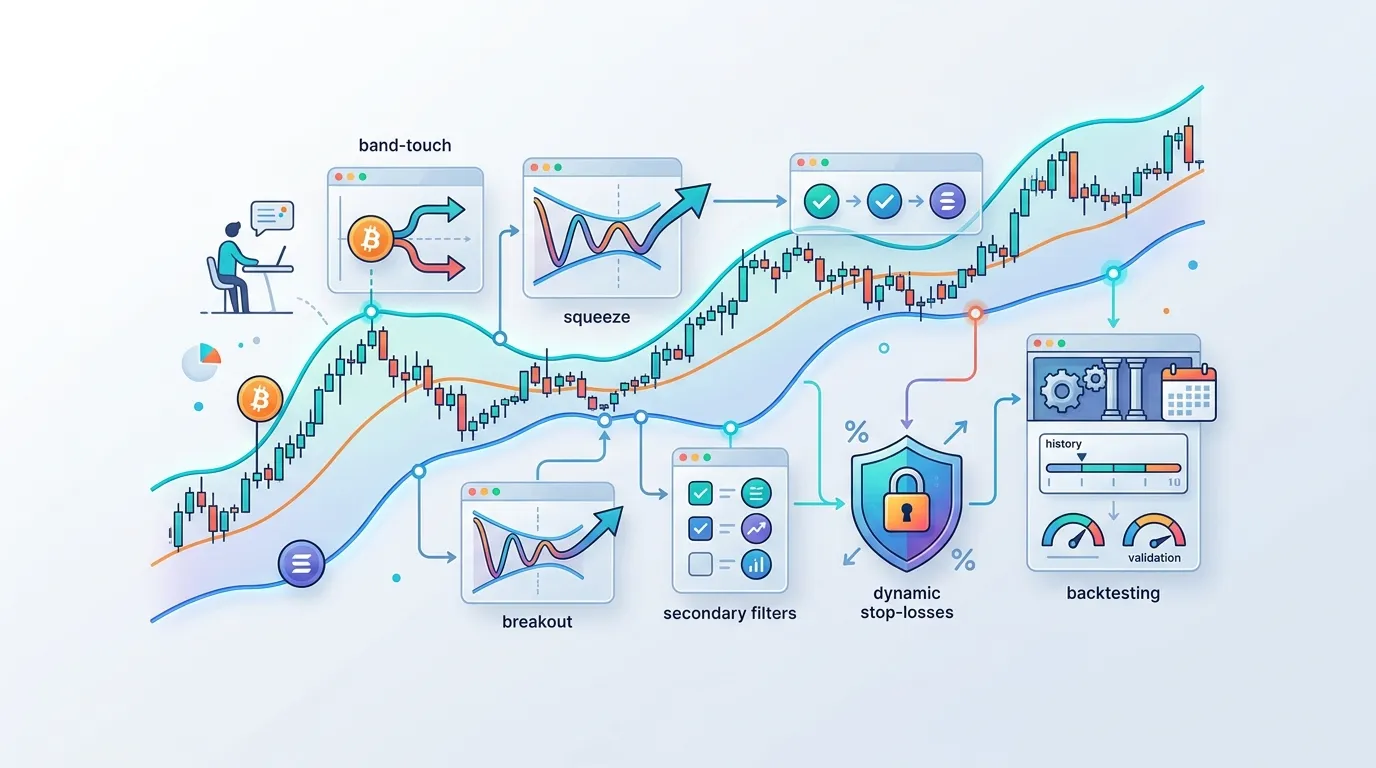
Learn how to configure a Bollinger Bands crypto trading bot with band-touch and squeeze-breakout logic, secondary filters, dynamic stop-losses, and backtesting to validate your setup before going live.