Crypto Market Screener for Trading Bots: A Practical Guide

Most automated trading losses don't come from a bad strategy — they come from applying a good strategy to the wrong pairs at the wrong time. A crypto market screener for trading bots solves that problem by acting as a pre-filter: it scans the entire market and hands your bot only the coins worth looking at. This guide walks you through exactly how screeners work, which indicators matter, and how to wire screener output into a bot that acts decisively.
What Is a Crypto Market Screener and Why Does It Matter?
A crypto market screener is a tool that scans a universe of trading pairs — sometimes hundreds or thousands — and applies a set of rules to surface only those that meet specific technical or volume-based criteria. Think of it as a triage layer that runs before your bot's strategy logic ever fires.
A screener doesn't predict where price goes. It narrows the field to pairs where conditions right now align with the setup your strategy is designed to exploit.
Without a screener, a bot running across 200 pairs generates enormous noise: low-probability signals on illiquid markets, false breakouts on thin-volume coins, and compounding fees on marginal trades. A well-configured screener cuts that list to 5–15 high-conviction candidates at any given refresh cycle.
What Filters Should a Crypto Screener Have for Automated Trading?
The filters you choose determine signal quality. The following are the most actionable for bot-integrated screeners:
1. Volume Spikes
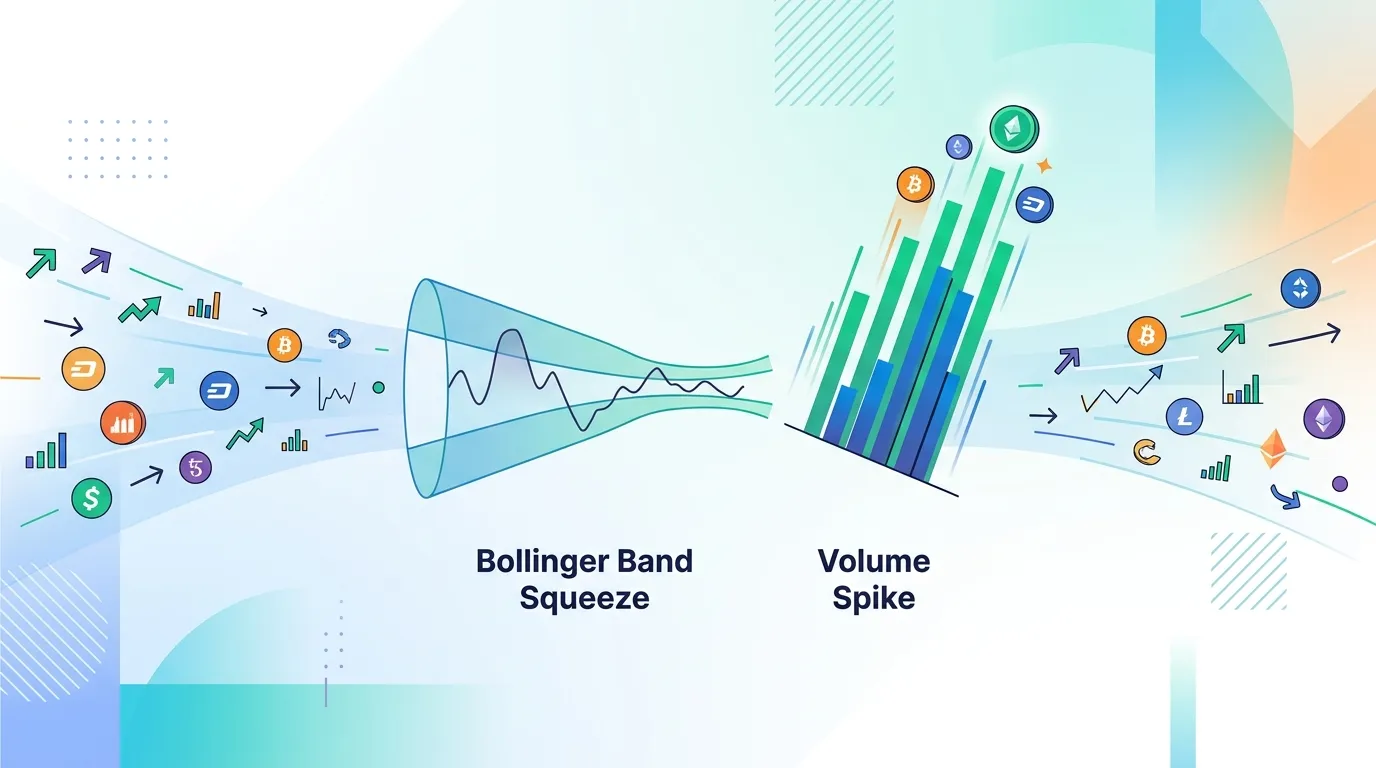
A sudden surge in 24-hour or 1-hour volume — typically defined as volume exceeding 1.5× to 3× its 20-period average — often precedes a directional move. Volume is the single most reliable leading confirmation for price breakouts.
2. RSI Overbought / Oversold Zones
The Relative Strength Index (RSI) oscillates between 0 and 100. Readings below 30 flag potential oversold conditions; readings above 70 flag potential overbought conditions. Screeners can filter for pairs where RSI has just crossed back out of these zones — a more reliable signal than entering mid-zone.
3. MACD Crossovers
A MACD line crossing above the signal line (bullish crossover) or below it (bearish crossover) within the last 1–3 candles is a time-sensitive signal. Screeners that surface fresh crossovers let your bot act while the setup is still valid.
4. Bollinger Band Squeezes
When the upper and lower Bollinger Bands tighten — measured as band width falling below a rolling minimum — the market is compressing energy before a breakout. Screening for squeezes lets you queue pairs before the move, not after it.
5. Minimum Liquidity and Market Cap Thresholds
Filter out pairs with less than, say, $500,000 in 24-hour volume or a market cap below a defined floor. Low-liquidity coins amplify slippage and make bot execution unreliable.
How Do Trading Bots Use Crypto Screeners to Find Opportunities?
A trading bot uses a crypto screener to shrink its universe of monitored pairs to a dynamic watchlist that changes with market conditions. The screener runs on a scheduled interval (e.g., every 5 minutes), applies its filter rules, and outputs a ranked or flagged list of pairs. The bot then evaluates only those pairs against its full entry-condition logic — reducing computation overhead and, more importantly, reducing exposure to low-quality setups.
A typical pipeline looks like this:
- Screener scan — evaluate all available pairs against volume, RSI, MACD, and band criteria.
- Watchlist output — produce a shortlist of 5–20 pairs that passed all filters.
- Bot strategy evaluation — run the full strategy (e.g., trailing stop configuration, position sizing, risk limits) only on watchlisted pairs.
- Order execution — if entry conditions are confirmed, the bot places the order via the exchange API.
Separating the discovery layer (screener) from the execution layer (bot) is one of the most effective ways to improve signal-to-noise ratio in algorithmic trading.
Can Trading Bots Be Integrated with Real-Time Crypto Screeners?
Yes — and the integration method determines how reactive your system is. There are three common approaches:
| Integration Method | Latency | Complexity | Best For |
|---|---|---|---|
| Shared database / in-memory queue | Very low (~seconds) | High | High-frequency setups |
| Webhook / push notification | Low (~5–30 sec) | Medium | Swing and intraday bots |
| Scheduled REST API poll | Medium (minutes) | Low | Daily or multi-hour strategies |
For most retail algorithmic traders, a webhook or scheduled poll at 1–5 minute intervals is sufficient. Platforms like Cryptohopper support external signal delivery, meaning your screener can push a filtered pair list to your bot via a signal endpoint rather than the bot polling the screener.
Which Crypto Exchanges Support API Access for Bot-Compatible Screeners?
The major exchanges with robust, well-documented public REST and WebSocket APIs suitable for screener builds include:
- Binance — tick-level WebSocket streams for 1,500+ pairs; extensive OHLCV endpoints.
- Coinbase Advanced Trade — reliable REST API; good for USD-denominated pairs.
- Kraken — strong API uptime record; supports both spot and futures data.
- Bybit — competitive rate limits; popular for derivatives screeners.
- OKX — broad asset coverage with low-latency market data feeds.
Always check the exchange's current API documentation for rate limits before designing your screener's refresh logic. Exceeding rate limits causes data gaps that corrupt indicator calculations.
What Are the Top Free Crypto Market Screeners for Algorithmic Trading?
Several free or freemium tools let you explore screener concepts before building a custom solution:
- TradingView Screener — filters by RSI, MACD, moving averages, and volume across hundreds of pairs. Limited API access on free tier.
- CoinMarketCap Screener — useful for liquidity and market-cap filtering; less suited for real-time technical indicators.
- Coinigy — includes basic technical screening with exchange connectivity; paid plans needed for API depth.
- Cryptohopper's Signal marketplace — built into the Cryptohopper platform; lets you subscribe to pre-built signal feeds that function like a managed screener output.
Free tools are excellent for prototyping filter logic and understanding what your screener should produce. For production use integrated with a live bot, a custom-built screener that you control gives you the flexibility to tune criteria without platform constraints.
Paper Trading vs. Live Trading: Validating Screener Signals First
Before routing screener output to a live bot, run it through a paper-trading phase. Paper trading executes your strategy against real market data without committing real capital, letting you measure:
- Hit rate — what percentage of screener-surfaced pairs actually moved in the expected direction?
- Signal latency — how many candles pass between screener detection and a viable entry?
- False positive rate — how often does a passed filter lead to a stop-loss exit within the first few candles?
A reasonable benchmark before going live: at least 100–200 screener-triggered paper trades across different market conditions (trending, sideways, volatile). Screener logic that looks great in a bull market often degrades badly in a choppy range — paper trading exposes this before it costs you real funds.
Cryptohopper's paper trading mode on cryptohopper.com lets you simulate full strategy execution on live price data, which pairs naturally with an externally validated screener watchlist.
Crypto trading carries substantial risk of loss. Paper trading and backtesting reduce — but do not eliminate — that risk. Past signal performance is not a guarantee of future results.
How to Build a Custom Screener with Cryptohopper.AI
If you want a screener built exactly to your specifications — specific indicators, your preferred exchanges, your own refresh intervals — Cryptohopper.AI lets you describe it in plain language and generates the code automatically. You might say something like:
"Build a crypto screener that checks Binance spot pairs every 3 minutes, filters for RSI below 32 with a bullish divergence, volume at least 2× the 20-candle average, and a fresh MACD crossover in the last 2 candles. Display results in a ranked table with pair, current RSI, volume ratio, and MACD histogram value."
Cryptohopper.AI generates the application code, deploys it automatically to a hosted subdomain (no manual deploy step required), and handles encrypted API key storage via KMS — your exchange credentials are never exposed in the generated code or logs. You can refine the screener iteratively by describing changes in plain language, and the platform's built-in AI Gateway means you can even add an LLM-powered commentary layer without managing your own API keys.
The result is a production-grade, hosted screener you control entirely — without writing a line of code.
Best Practices: Reducing Noise and Avoiding False Positives
Even well-designed screeners surface bad signals. These practices keep false positives in check:
- Require multiple filter conditions to fire simultaneously — a volume spike alone is weak; a volume spike plus an RSI recross plus a MACD crossover is meaningful.
- Set a minimum candle-close confirmation — don't act on a signal until the candle that triggered it has closed. Wicks can temporarily breach RSI or Bollinger thresholds and then revert.
- Use higher timeframes as a trend filter — only surface bullish signals on lower timeframes when the 4-hour or daily trend is also bullish. Trend alignment dramatically improves hit rates.
- Tune refresh intervals to your strategy timeframe — a swing strategy doesn't need 30-second refreshes; a 5–15 minute interval reduces API load and prevents acting on micro-noise.
- Log every screener output — storing what the screener surfaced (and what it missed) is the only way to tune filter parameters systematically over time.
Wrapping Up
A crypto market screener for trading bots isn't a luxury — it's the layer that separates disciplined algorithmic trading from random noise. By filtering pairs on volume, RSI, MACD, and Bollinger criteria before your bot's strategy logic runs, you reduce false positives, lower execution costs, and focus your bot's attention where market conditions actually align with your setup. Validate with paper trading, combine multiple filters, and build a screener you can iterate on — because market conditions change, and your pre-filter logic should change with them.
Frequently asked questions
What is the best crypto market screener for trading bots?
There is no single universally best screener — the right choice depends on your strategy, exchange, and timeframe. TradingView's screener is the most widely used free tool for visual filtering. For production bot integration, a custom-built screener tied directly to your exchange's API and outputting to your bot's signal endpoint typically outperforms generic platforms, because you can tune every filter parameter to your exact strategy logic.
How do trading bots use crypto screeners to find opportunities?
A trading bot uses a screener to shrink its monitored universe from hundreds of pairs down to a short dynamic watchlist of high-signal candidates. The screener applies technical and volume-based rules on a scheduled interval, outputs a filtered list, and the bot then runs its full entry-condition logic only on those pairs. This separation of discovery (screener) from execution (bot) reduces noise and improves signal quality.
Can trading bots be integrated with real-time crypto screeners?
Yes. The most common integration methods are: a shared in-memory queue or database for very low latency, webhook-based push notifications for intraday bots, and scheduled REST API polling for longer-timeframe strategies. Platforms like Cryptohopper support external signal delivery, so a screener can push filtered pair data to your bot directly rather than the bot having to poll the screener.
What filters should a crypto screener have for automated trading?
The most actionable filters for bot-compatible screeners are: volume spikes (current volume significantly above a rolling average), RSI overbought/oversold zones (especially recrosses of the 30 and 70 levels), MACD line crossovers within the last 1-3 candles, Bollinger Band squeezes signaling a pending breakout, and minimum liquidity thresholds to exclude thinly traded pairs that cause excessive slippage.
Which crypto exchanges support API access for bot-compatible screeners?
Binance, Coinbase Advanced Trade, Kraken, Bybit, and OKX all offer well-documented REST and WebSocket APIs suitable for building screeners. Binance is the most commonly used due to its broad pair coverage and low-latency WebSocket streams. Always review each exchange's current rate limits before designing your screener's refresh logic, as exceeding them creates data gaps that corrupt indicator calculations.
Subscribe to the Cryptohopper newsletter
New posts, product updates, and the occasional lesson — straight to your inbox.
We'll never share your email. Unsubscribe anytime.
Related articles
Crypto Market Screener Bot: Bollinger Band Squeeze & Volume Spike Guide
Learn how to build a crypto market screener bot that automatically surfaces high-probability setups by filtering coins on Bollinger Band squeezes and volume spikes.

How to Build a Crypto Price Alert Bot That Monitors RSI and Bollinger Bands
Learn how to build a crypto price alert bot that monitors RSI overbought/oversold levels, Bollinger Band breakouts, and MACD changes — and fires real-time notifications before a trade signal is acted upon.

MACD Crossover Crypto Trading Bot: A Complete Builder's Guide
Learn how to build a MACD crossover crypto trading bot that reads histogram momentum shifts to automate entries and exits — from signal logic to parameter tuning and backtesting.