Crypto Grid Trading Bot: A Complete Builder's Guide

Grid trading is one of the oldest systematic trading strategies in financial markets, and it translates remarkably well to crypto. Yet most guides treat it as a black box — you either buy a pre-built tool or you're on your own. This article breaks the strategy down from first principles, walks you through every parameter you need to configure a crypto grid trading bot, and explains how to move from concept to a live, tested deployment safely.
What Is a Crypto Grid Trading Bot and How Does It Work?
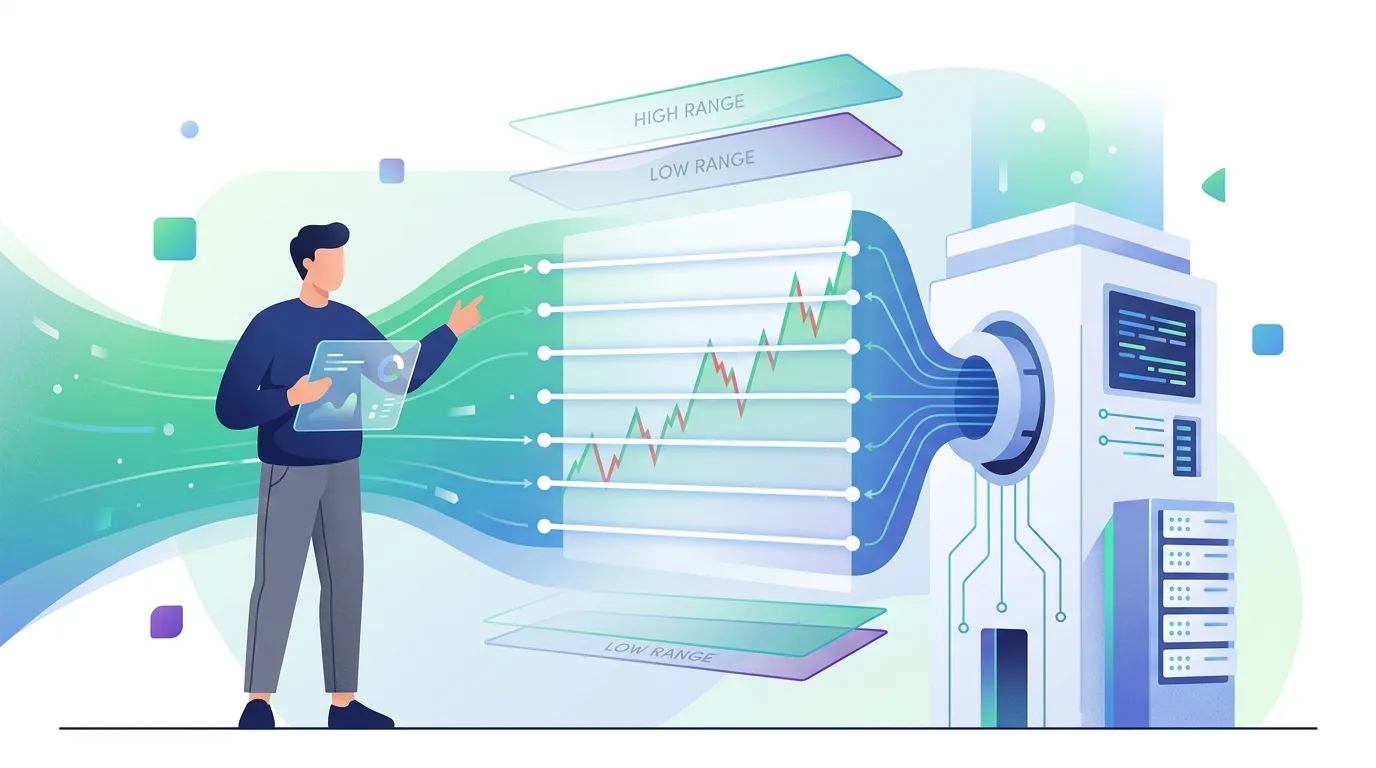
A crypto grid trading bot is an automated program that places a ladder of buy and sell limit orders at evenly spaced price intervals within a defined range. When the price dips to a buy level, the bot fills that order and immediately places a corresponding sell order one grid step above it. When the price rises to a sell level, the bot fills it and places a new buy order one step below. Every completed buy-sell cycle locks in a small profit equal to the grid spacing minus fees. The bot repeats this loop continuously, capitalising on the price oscillations that characterise sideways or range-bound crypto markets — no directional prediction required.
Grid trading does not require you to forecast where price is going — it systematically harvests volatility within a range, turning market noise into a sequence of small, repeatable gains.
How Grid Trading Differs From Regular Crypto Trading
Most retail crypto trading is directional: you buy because you believe price will rise, or short because you believe it will fall. Grid trading is fundamentally different — it is market-neutral within its range. You are not taking a view on direction; you are harvesting the bid-ask oscillation that naturally occurs as buyers and sellers push price back and forth.
| Dimension | Directional Trading | Grid Trading |
|---|---|---|
| Market view required | Yes — bullish or bearish | No — works in sideways markets |
| Order type | Typically market or single limit | Stacked ladder of limit orders |
| Profit source | Price trend | Repeated small oscillations |
| Best market condition | Trending | Range-bound / choppy |
| Manual intervention | Often high | Low once configured |
| Risk profile | Directional loss if wrong | Capital locked; breakout risk |
The trade-off is straightforward: grid bots excel in ranging markets and underperform when price makes a sustained trend outside the configured range.
Is Grid Trading Profitable in Crypto Markets?
Grid trading can generate returns in range-bound conditions, but it is not inherently profitable in all market environments, and it carries real risks. Historical data on BTC/USDT and ETH/USDT shows extended periods of consolidation — weeks or months where price oscillates within a 10–20% band — that are theoretically favourable for grid strategies. However, crypto markets also experience sharp, sustained breakouts (both up and down) that can leave a grid bot holding a deteriorating position or missing a strong move entirely.
The honest answer: grid trading is an approach with identifiable edge in specific conditions, not a guaranteed income stream. Whether it is profitable for you depends on parameter choices, the asset pair, market timing, and how you manage breakout risk. Trading crypto carries substantial risk of loss, and past performance of a strategy never guarantees future results.
Key Parameters to Configure Before You Build
Getting these six parameters right is the real work of building a grid bot. Rushing them is the most common source of poor results.
- Upper price bound — The ceiling of your grid. Orders at or above this level are sell-only. Set it at a meaningful resistance level or a fixed percentage above current price.
- Lower price bound — The floor of your grid. Orders at or below this level are buy-only. Align it with a strong support level or a fixed percentage below current price.
- Number of grid levels — How many horizontal lines divide your range. More levels mean smaller profit per cycle but more frequent fills. A common starting point is 10–20 levels.
- Order size — The base-asset quantity placed at each grid level. This determines your total capital commitment:
order size × number of levels × average price ≈ total capital deployed. - Asset pair — Choose a pair with sufficient volume and volatility within your range. Low-liquidity pairs produce wide spreads that eat into the thin per-grid margin.
- Fee awareness — Your grid spacing must exceed the round-trip maker fee on the exchange (typically 0.1–0.2% per side). A grid spacing tighter than your fee costs money on every cycle.
How to Set Up a Grid Trading Bot for Cryptocurrency
Step 1 — Define your range on a chart
Before writing a single instruction, spend time with a price chart. Identify a recent consolidation zone — a period of at least two to four weeks where price oscillated without a decisive breakout. Your upper and lower bounds should bracket that zone with a small buffer on each side.
Step 2 — Calculate grid spacing and capital requirements
With your range and number of levels decided, calculate per-level spacing:
Grid spacing % = (upper_bound − lower_bound) / lower_bound / (grid_levels − 1) × 100
If your spacing is less than 0.5% on a 0.1% fee exchange, widen the range or reduce grid levels.
Step 3 — Describe the bot in plain language
Tools like Cryptohopper.AI let you describe exactly what you want in a chat interface and generate the bot's code automatically. You connect your Cryptohopper account via OAuth, and the builder handles deployment. An example prompt might read:
"Build a grid trading bot for BTC/USDT. Set the lower bound at $58,000 and the upper bound at $72,000. Create 15 equal grid levels. Each order should be 0.002 BTC. When price hits a sell level, immediately place a buy order one step below. Add a stop-loss that cancels all open orders and sells the full position if price closes below $55,000."
The AI interprets these plain-language instructions, generates the underlying code, and deploys it automatically to a hosted environment — no manual deploy step, no infrastructure to manage.
Step 4 — Secure your exchange API keys
Your bot needs read and trade permissions on your exchange account. In the Cryptohopper ecosystem, you connect your exchange credentials through your Cryptohopper account. Cryptohopper.AI then injects those secrets at runtime using encrypted storage backed by AWS KMS — your API keys are never embedded in generated code or exposed in logs. Use IP-whitelisting on the exchange side and grant only the minimum permissions the bot needs (trade + read balance; never withdrawal).
Backtesting Your Grid Strategy on Historical Data
Backtesting simulates how your grid would have performed on past price data. It does not predict the future, but it does expose obvious flaws — a range that would have been broken immediately, a grid spacing that earns less than fees, or a stop-loss level that triggers on routine noise.
When you describe a grid bot via Cryptohopper.AI, you can extend your prompt to include a backtesting component:
"Also build a backtester that replays the last 90 days of hourly BTC/USDT candles from the Cryptohopper data feed, simulates fills at each grid level assuming 0.1% maker fees, and outputs a P&L curve, total cycles completed, and maximum drawdown."
The backtester becomes a separate panel in the same generated project, giving you a concrete number for average daily cycles and fee drag before you deploy with real funds.
A backtest that shows fewer than two completed cycles per day on your target pair is a signal to widen grid spacing or choose a more volatile asset.
What Are the Risks of Using a Grid Trading Bot?
Breakout risk — the most important one
If price breaks decisively above your upper bound, the bot holds only quote currency (e.g., USDT) and misses the entire up-move. If price breaks below your lower bound, the bot is fully loaded with base currency (e.g., BTC) at a loss. A sustained downtrend can turn a grid bot into an involuntary buy-and-hold position at depreciating prices.
Mitigation: Define a hard stop-loss below the lower bound. In your bot prompt, specify: "If price closes two consecutive 4-hour candles below [lower bound − 3%], cancel all open grid orders and execute a market sell of all held base currency."
Capital lock-up
A grid bot ties up capital across all levels simultaneously. That capital cannot be deployed elsewhere. Size your grid to represent only the portion of your portfolio you can afford to have fully committed to a single pair.
Fee accumulation
Dozens of small cycles per day can rack up significant cumulative fees. Build a fee tracker into your dashboard so you can monitor whether gross profit is outpacing fee drag in real time.
Exchange downtime and API errors
Exchanges experience outages. Build retry logic and an alerting mechanism into your bot — a simple webhook to a Telegram or Discord channel when an order fails to fill or an API call returns an error is enough to let you intervene manually.
Wrapping Up
A crypto grid trading bot is a powerful tool for systematically extracting value from range-bound markets — but it rewards careful configuration and clear-eyed risk management, not set-and-forget complacency. Define your range with chart analysis, calculate spacing to beat fees, backtest on real historical candles, and always define the breakout condition where the bot stops and gets out. If you want to build one without writing boilerplate from scratch, Cryptohopper.AI lets you describe your grid logic in plain language and handles code generation, secure secret management, and deployment automatically — so you can spend your time on strategy, not infrastructure.
Frequently asked questions
What is a crypto grid trading bot and how does it work?
A crypto grid trading bot places a ladder of buy and sell limit orders at evenly spaced price levels within a defined range. When price drops to a buy level, the bot fills the order and places a sell order one step above. When that sell fills, it places a new buy below. Each completed cycle captures a small profit equal to the grid spacing minus fees. The bot repeats this continuously, profiting from price oscillations without needing to predict market direction.
Is grid trading profitable in crypto markets?
Grid trading can be profitable during range-bound, sideways market conditions where price oscillates within a defined band. It tends to underperform in strongly trending markets, where price breaks out of the configured range and leaves the bot either fully in cash (missing an uptrend) or holding a depreciating asset (during a downtrend). Profitability depends on parameter choices, fee structure, asset volatility, and breakout risk management. Crypto trading involves substantial risk of loss, and no strategy guarantees returns.
What are the best crypto grid trading bots available?
Several platforms offer grid trading bots, including Cryptohopper, 3Commas, Pionex, and Bitsgap, each with different interfaces, supported exchanges, and fee structures. Cryptohopper.AI takes a different approach, letting you describe your grid bot logic in plain language and generating custom code that is deployed and hosted automatically. The best choice depends on your technical comfort level, preferred exchange, and how much you want to customise the strategy beyond pre-set templates.
What are the risks of using a grid trading bot?
The primary risk is a price breakout beyond the configured range. If price drops below the lower bound, the bot accumulates the base asset at a loss. If price rises above the upper bound, the bot is fully in quote currency and misses the rally. Additional risks include capital lock-up across all grid levels, fee accumulation eroding thin per-cycle margins, and exchange API outages that prevent order placement. Pairing the bot with a hard stop-loss and monitoring alerts significantly reduces these risks.
How do you set up a grid trading bot for cryptocurrency?
Start by identifying a consolidation zone on a price chart to set your upper and lower bounds. Then decide on the number of grid levels (commonly 10–20) and calculate per-level spacing to ensure it exceeds your exchange's round-trip fee. Size each order so total capital deployed fits within your risk budget. Connect your exchange API keys securely through your trading platform account, define a stop-loss for breakout scenarios, and backtest on historical candles before deploying with real funds.
Subscribe to the Cryptohopper newsletter
New posts, product updates, and the occasional lesson — straight to your inbox.
We'll never share your email. Unsubscribe anytime.
Related articles
Crypto Grid Trading Bot: A Complete Setup Guide for 2025
Learn how a crypto grid trading bot works, how to configure price ranges and grid levels, and how to build and deploy one using Cryptohopper.AI — no coding required.

DCA Crypto Trading Bot: How It Works and How to Build One
Learn how a DCA crypto trading bot automates dollar-cost averaging, how to configure intervals, order sizes, and safety orders, and how to build a custom DCA bot without writing code.

Bollinger Bands Crypto Trading Bot: A Practical Setup Guide
Learn how to configure a Bollinger Bands crypto trading bot with band-touch and squeeze-breakout logic, secondary filters, dynamic stop-losses, and backtesting to validate your setup before going live.